360 Video Real Estate or AI-Generated Videos? A Practical Comparison for Agents

Summarize with AI


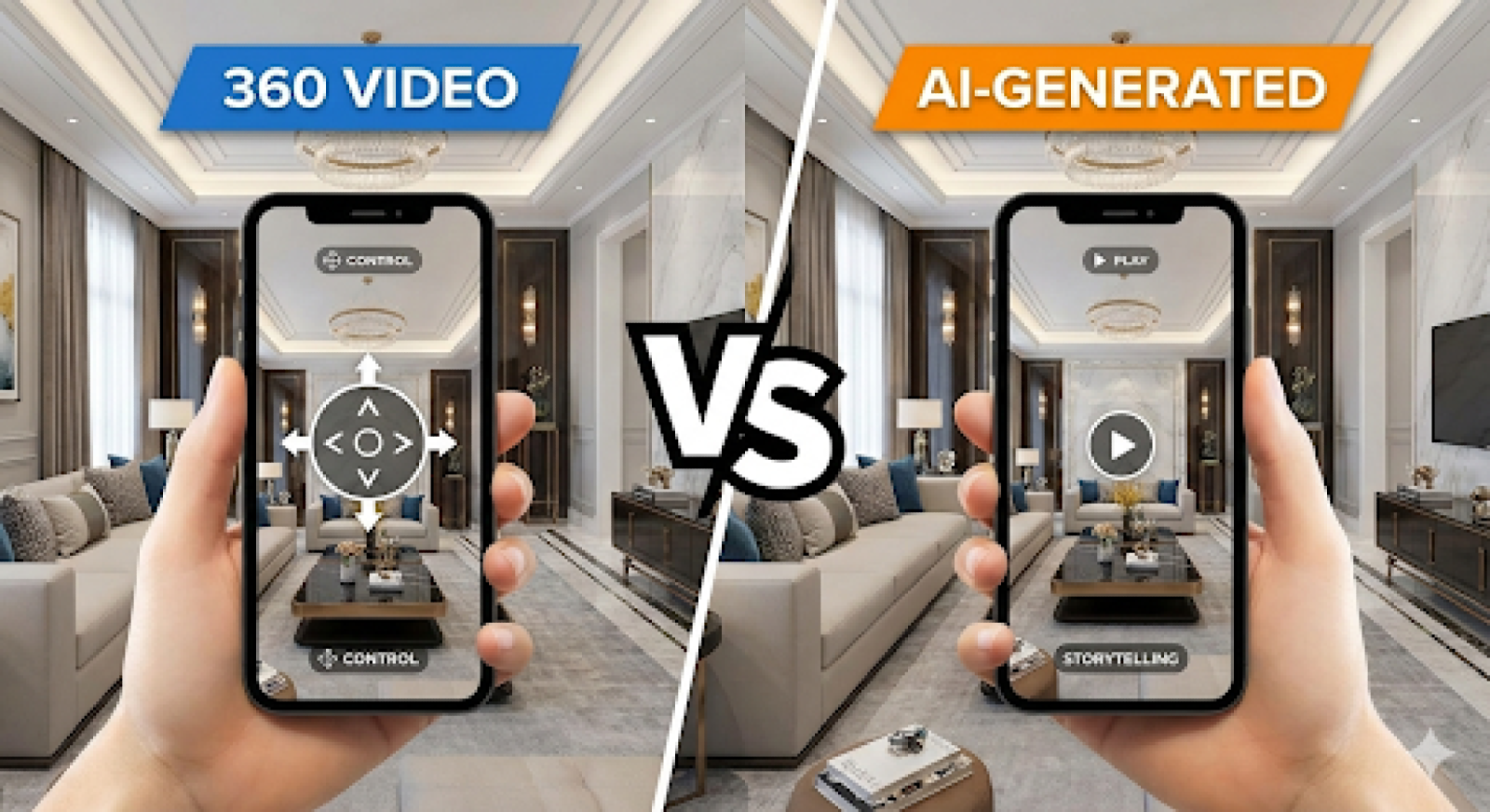
Most high-performing agents in 2026 use AI video on every listing and reserve 360 tours for listings where layout is the selling point.
Why?
AI-generated property videos win for speed, cost, and social reach and the 360 video wins for spatial evaluation.
An AI video is generated from listing photos in minutes for a few dollars; a 360 tour requires on-site capture and specialized processing but lets buyers explore rooms themselves.
The stakes behind the choice: listings with video receive 403% more inquiries than photo-only listings (PhotoUp, 2026), and with every buyer now searching online — 70% on mobile (NAR 2025) — the format you pick decides where your listing can even show up.
Here's the practical comparison guidebook that explains different features of 360 video real estate vs AI-generated videos.
What Is 360 Video Real Estate?
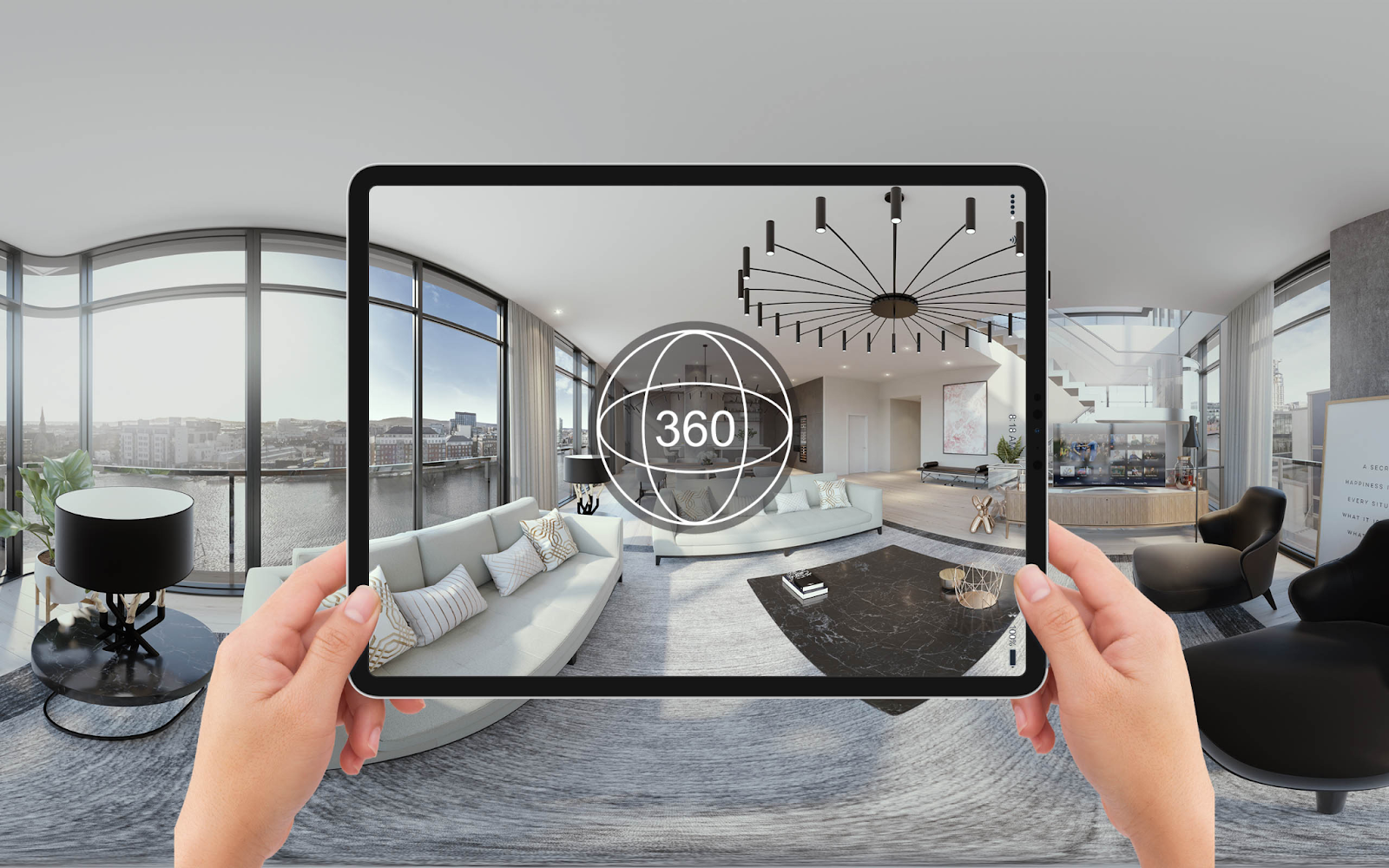
360 video real estate is an interactive format that lets buyers control their viewing perspective inside a property. Omnidirectional cameras capture a spherical view from fixed positions; stitching software turns the footage into a navigable tour, usually hosted on a virtual tour platform and embedded in the listing page or MLS link.
Agents still use it for good reasons:
- Accurate floor-plan flow.
- Less ambiguity for remote and relocation buyers.
- Long dwell times from high-intent viewers on desktop.
The trade-off is friction — viewers must actively navigate, which works poorly in mobile feeds.
What Are AI-Generated Property Videos?
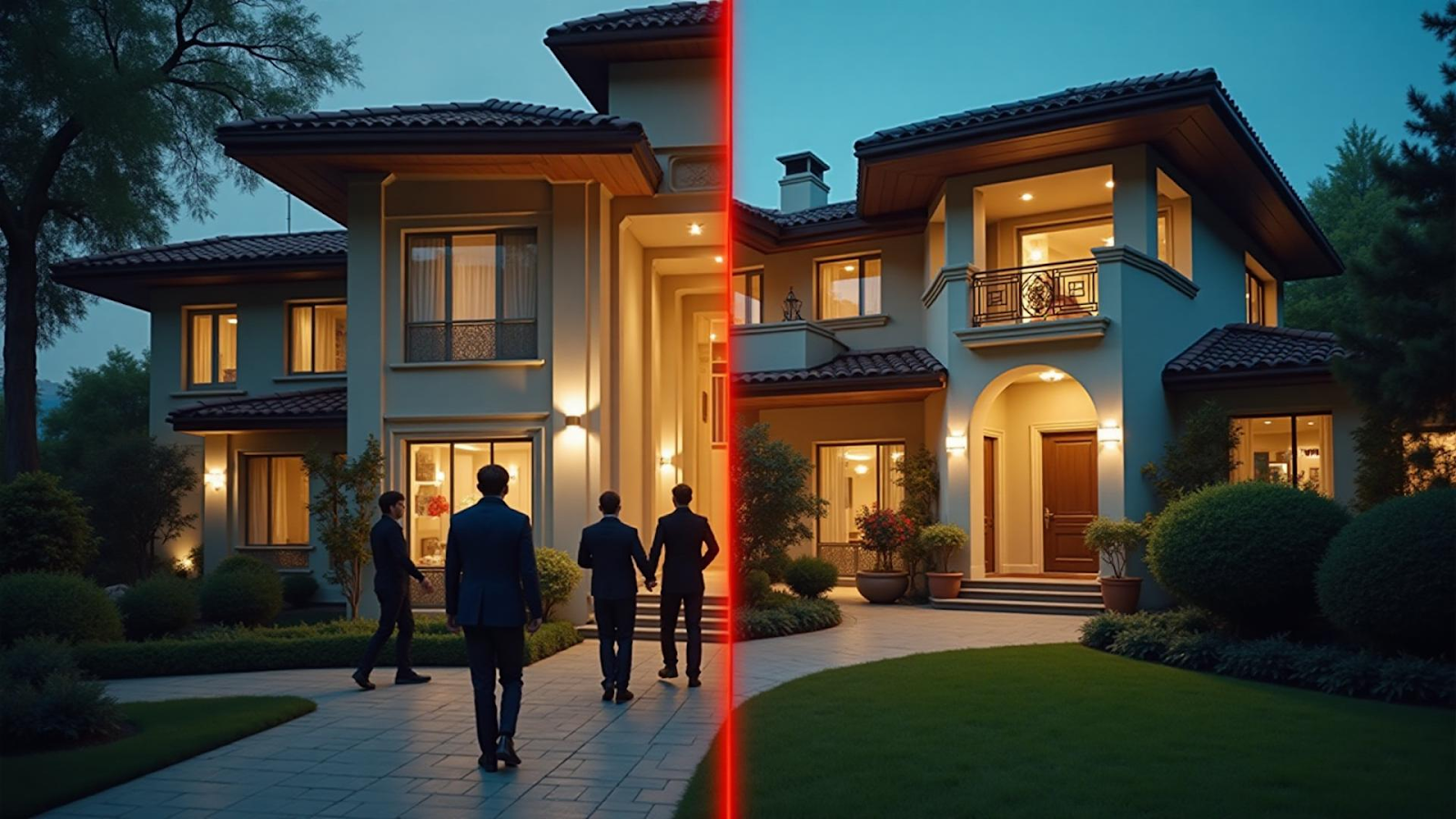
AI-generated property videos are built from still listing photos rather than filmed footage. Computer vision identifies what's in each photo, applies realistic camera motion and depth simulation, and sequences the clips into a linear, walkthrough-style video — typically ~30 seconds, optimized for social platforms and listing portals.
The viewer doesn't navigate; the video guides them. That passive, story-driven experience is exactly what performs in scroll-based environments — and it's why AI property videos have become the scalable default.
For the deeper mechanics, see our guide to what AI video for real estate actually is.
360 Video vs AI-Generated Property Videos: Production Reality Check
The operational difference between 360 video real estate and AI-generated property videos is stark. 360 capture errors mean going back to the property. AI rendering is repeatable — upload photos, get video, every time.
Here is a table explaining the difference between these two video genres.
| Factor | 360 video real estate | AI-generated property videos |
|---|---|---|
| On-site capture | Required | Not required — photos only |
| Equipment | 360 camera, tripod, hosting platform | None |
| Processing | Manual stitching and QA | Automated rendering |
| Turnaround | Days (reshoots if capture fails) | ~10 minutes |
| Scalability | Limited by site visits | High — every listing, same day |
Which Format Makes Financial Sense?
Traditional property video production runs $500–$1,200+ per listing; professional 360 tours add equipment, capture time, and hosting fees.
AI-generated videos cost roughly $10 per video on subscription plans — low enough to include video on every listing rather than rationing it to premium ones.
That per-listing math is why photographers and media companies report strong margin expansion reselling AI videos: minimal labor, fast delivery, flexible resale pricing.
The full breakdown is in our DIY vs videographer vs AI cost comparison.
Buyer Experience: Control vs. Storytelling
The principle: control supports evaluation; storytelling drives discovery. A 360 tour helps an engaged buyer decide; an AI video creates that engaged buyer in the first place.
Here is a table explaining the buyer experience on different parameters.
| Experience | 360 video | AI-generated video |
|---|---|---|
| Navigation | User-driven | Guided by the video |
| Narrative flow | Absent | Present |
| Mobile experience | Moderate — requires interaction | High — passive viewing |
| Social performance | Limited | Strong |
When Is 360 Video the Right Choice?
Used this way, 360 is a decision-support tool — a complement, not the primary marketing asset.
- It offers complex layouts where room-to-room context sells the home.
- Its key audience is relocation and international buyers who can't visit.
- It works for luxury listings in the consideration stage.
- It suits dedicated property pages with engaged traffic.
When Do AI Property Videos Work Better?
This is AutoReel's home turf: listing photos become a posting-ready property video in about 10 minutes, in vertical and landscape, with virtual staging and photo edits included.
- It offers same-day listing launches with no post-production dependency.
- It is suited for social-led marketing, where short vertical video drives discovery.
- It works for budget-conscious operations that want video on every listing.
- It offers multi-listing consistency for team and brand alignment.
AutoReel workflow has flawlessly produced 200,000+ videos and earned a 4.9★ rating across 360+ reviews. It's how media companies scale to 50 videos a week without hiring.
Property Videos AI: Which Tools Do Agents Actually Use?
Searching "property videos AI" surfaces a growing field. The names agents ask about most:
- AutoReel — the real-estate-first AI video platform: photo-to-video in ~10 minutes plus virtual staging, AI photo edits, voiceovers, avatars, and a built-in Studio editor. It is built for agents, photographers, and media companies.
- Reel-E — fast AI listing videos (~2 minutes): aimed at solo agents, from ~$44/month; no staging or photo-editing tools.
- PropertyVideos.ai — an AI property video service: in the same photos-to-video category; feature depth and pricing vary, so compare current offerings directly.
- AgentPulse — an AI real estate video tool: as with any newer entrant, evaluate output realism and format coverage before committing.
Whichever you test, apply the same four filters:
- Realism of motion (no warped walls)
- Formats included (9:16 and 16:9 from one upload)
- What's bundled (staging, edits, branding)
- Proof (review volume and visible customer results)
Our ranked guide to AI tools for agents runs this comparison in full.
How Do These Formats Fit 2026 Video Trends?
The real estate video marketing trends of 2026 — short-form dominance, vertical-first framing, and consistency over perfection — all favor linear AI video for discovery, with immersive formats as depth for engaged buyers. The agents winning attention publish an AI video per listing and layer 360 selectively.
Full trend breakdown with data: 10 real estate video marketing trends for 2026.
Which Video Strategy Should You Choose?
The choice of your video strategy depends on multiple factors. Here is a table explaining which video format is suitable based on different factors.
| Priority | Recommended format |
|---|---|
| Speed to market | AI-generated property videos |
| Cost efficiency | AI-generated property videos |
| Layout clarity for engaged buyers | 360 video |
| Social distribution and lead flow | AI-generated property videos |
| High-consideration luxury listings | Both — AI for reach, 360 for depth |
Bottom Line
Format follows function. AI-generated real estate videos earn attention at scale; 360 property video supports decisions on the listings that warrant it.
Start where every listing benefits: create your first AI property video free — 2 videos a month, no credit card required.
Format follows function
AI video for every listing, in about 10 minutes. Layer 360 tours only where layout is the sell.
FAQs
1. Is 360 video real estate still relevant in 2026?
2. Which is cheaper: 360 tours or AI property videos?
3. What is the best AI property video tool?
4. Can I use both formats on one listing?
5. Do AI property videos work for luxury listings?
6. How long does each format take to produce?
Sources: