9 Social Media Marketing Trends for Real Estate Professionals (That Actually Drive Listings in 2026)

Summarize with AI


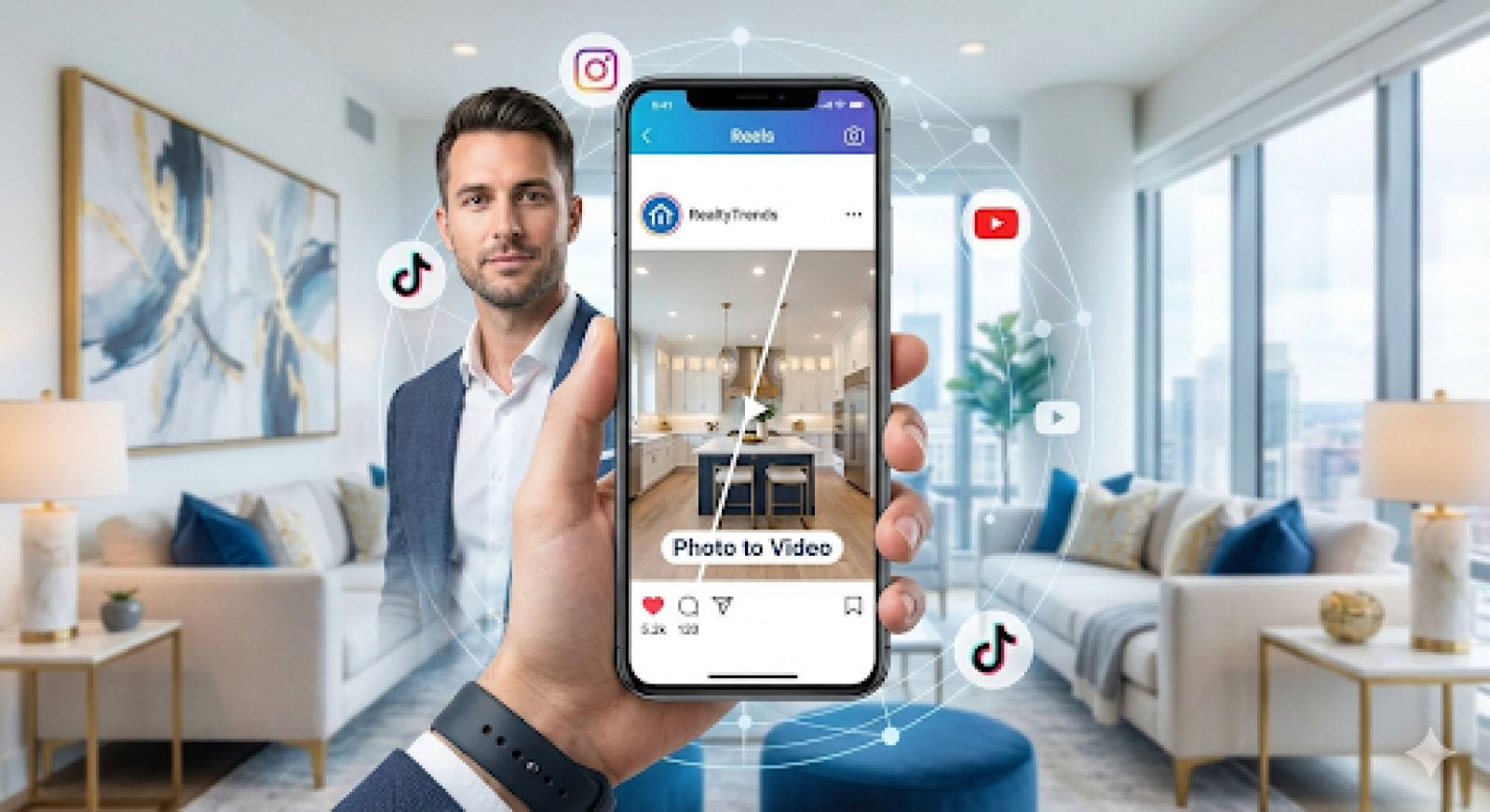
Social media is no longer “optional marketing” for agents. It’s your storefront, your credibility engine, and often your first showing.
Over 90% of homebuyers start their search online. Increasingly, they discover properties through Instagram Reels, YouTube Shorts, Facebook feeds, and even TikTok before they ever visit Zillow. That means real estate marketing on social media is no longer about posting photos — it’s about storytelling, speed, and smart automation.
If you want to stay competitive in 2026, here are the 9 real estate social media marketing trends reshaping how listings are marketed and how agents build authority.
1. Short-Form Video is Now the Primary Listing Format

Static photos don’t stop the scroll anymore. Short-form video does.
Instagram Reels, YouTube Shorts, and TikTok are dominating organic reach. Video receives significantly higher engagement, longer watch time, and better algorithmic distribution compared to static posts.
What this means for realtors:
- Every listing should have a video version
- Vertical format is no longer optional
- Videos need to be fast, dynamic, and under 60 seconds
For a deeper breakdown of how short-form property videos are outperforming static listings, explore our guide on real estate video marketing trends for 2026.
Agents using AI-powered tools to turn listing photos into cinematic reels in minutes are winning. Instead of hiring videographers for every property, scalable platforms like AutoReel convert listing photos into dynamic videos with transitions, captions, music, and branded elements — ready for posting across platforms.
This shift isn’t about trends. It’s about visibility.
What brokers are experiencing
“AutoReel transforms photos into beautiful, realistic video walkthroughs. The Drone ‘flyovers’ are truly incredible! A must-have tool for realtors in a digital-first world.” — Nicole Causey, Co-Founder, Everhome Realty
For brokerages operating in competitive markets, video quality can directly influence listing perception and seller confidence.
2. AI-Powered Content Creation is Replacing Manual Editing

One of the biggest social media trends for realtors is automation.
Agents don’t have time to:
- Edit videos manually
- Adjust lighting in Photoshop
- Create multiple social versions
- Record voice-overs repeatedly
AI now handles:
- Photo-to-video transformation
- Automatic captions
- AI voiceovers
- Virtual staging
- Sky replacements
- Twilight conversions
This shift toward automation is transforming how media teams operate — we break this down in detail in our article on why real estate media is rapidly shifting to AI content generation.
What real estate media professionals are saying
“The future is here! AutoReel surpasses the rest in terms of quality and accuracy. The generations look authentic with clean movements and tasteful add-ons.” — Kerry Riordan, Owner, Blu Lemonade Photography
For media professionals producing content at scale, quality and realism aren’t optional — they’re expected.
3. Personal Branding > Brokerage Branding
One of the strongest real estate branding trends: buyers follow people, not logos.
Realtors who position themselves as:
- Market educators
- Neighborhood experts
- Lifestyle advisors
- Community connectors
… generate more inbound leads.
Your face + your voice + consistent visual style = recognition.
Many solo agents are scaling faster by systemizing their branding with AI-powered listing videos — here’s how solo realtors are using video marketing to grow faster.
Video helps here. When agents add AI voiceovers or branded intros/outros to listing videos, they reinforce authority without spending hours editing.
Consistency builds recall. Recall builds trust.
4. “Behind-the-Scenes” Transparency Builds Trust
Highly polished marketing is no longer enough. Buyers want authenticity.
Trending formats include:
- “Just listed — here’s why this one is special”
- Before-and-after virtual staging transformations
- Day-in-the-life realtor content
- Walkthrough narration clips
Combining authenticity with professional visuals is the sweet spot.
Agents who use AI-enhanced visuals (clean skies, decluttered rooms, virtual staging) while maintaining honest storytelling build higher trust and engagement.
Transparency + technology = modern credibility.
5. Virtual Staging is Becoming a Social Media Essential
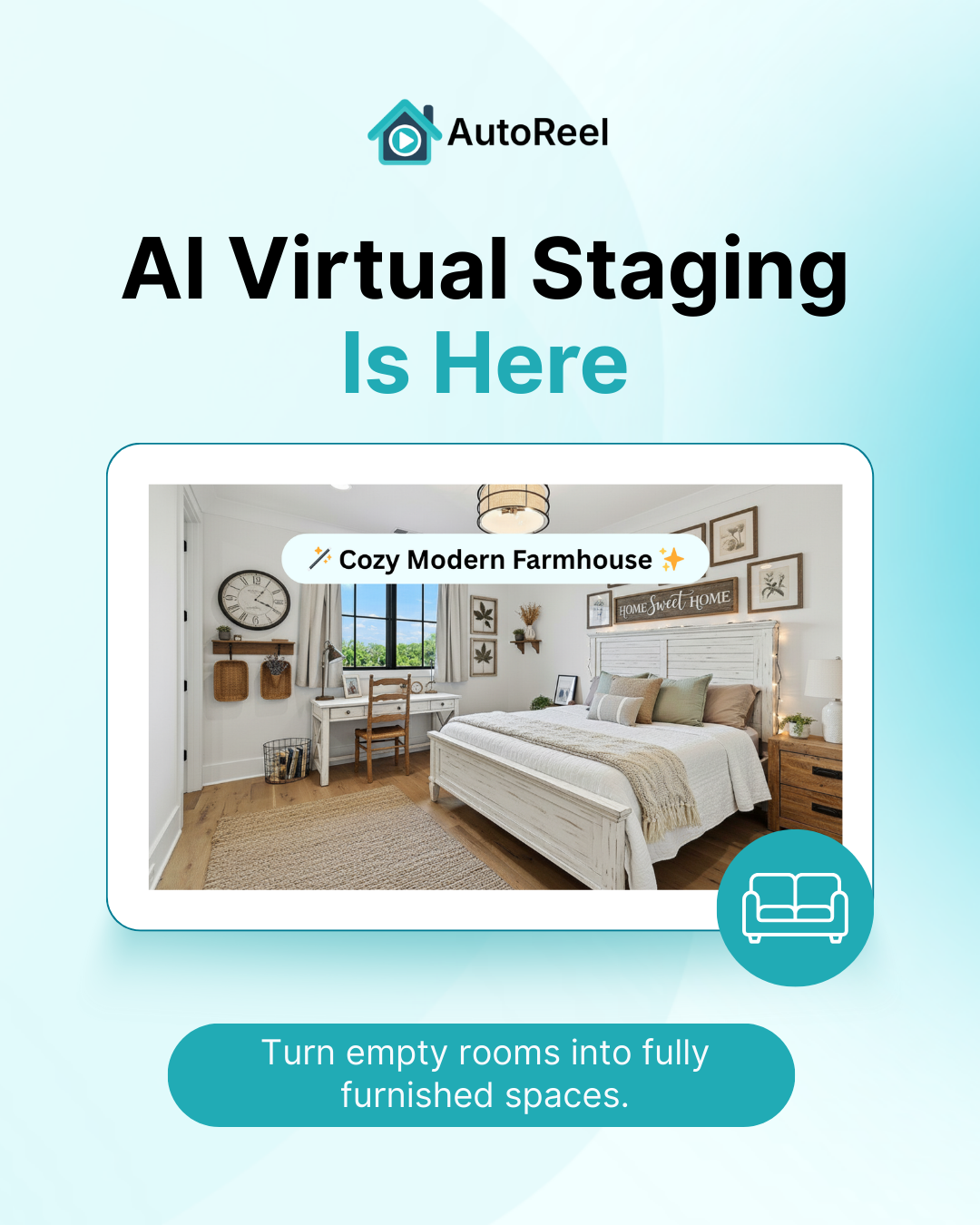
Empty rooms perform poorly on social feeds.
Virtually staged rooms:
- Increase engagement
- Help buyers visualize layout
- Make listings feel move-in ready
Instead of paying thousands for traditional staging, AI virtual staging allows agents to:
- Test multiple design styles
- Stage vacant listings instantly
- Customize visuals for different target buyers
When these staged images are converted into short-form videos, the performance jump is noticeable.
If you're exploring how virtual staging and video combine to increase listing engagement, this breakdown of why real estate agents need video marketing (with stats) offers helpful context.
Agents who combine virtual staging + video creation from the same workflow save time and reduce friction — which is why integrated platforms are gaining traction.
6. Platform-Specific Formatting is Critical

Posting the same content everywhere no longer works.
Modern realtor social media strategies require:
- Vertical 9:16 for Reels and TikTok
- Square for Instagram feed
- Landscape for YouTube
- MLS-friendly formatting
The trend is not “post more.” It’s “post smarter.”
AI video tools now export multi-format versions instantly, eliminating the need to resize manually. For high-volume agents and media houses, this is a competitive advantage — especially when handling dozens of listings monthly.
7. Story-Driven Property Marketing Outperforms Feature Lists
Listing posts that say:“3 bed | 2 bath | 1,800 sqft”
… get ignored.
Posts that say:“Imagine hosting summer dinners in this backyard…”
… get saved and shared.
Emotion drives engagement.
The best-performing real estate marketing on social media:
- Shows lifestyle, not specs
- Uses cinematic camera movement
- Adds music to create mood
- Includes subtle text overlays
AI-generated flyover-style motion effects and automated storytelling sequencing are making cinematic marketing accessible to solo agents — not just luxury brokers.
8. Speed-to-Market is a Competitive Advantage
Delays kill momentum. Listings that launch quickly with strong visuals get more early traction.
Traditional workflow:
- Photographer
- Editor
- Video editor
- Designer
- Social media formatting
Modern workflow:
- Upload photos
- Auto-generate staging
- Convert to video
- Export platform-ready formats
- Publish same day
Speed is now part of brand perception. Agents who consistently post polished listing videos within hours of going live appear more organized, tech-forward, and client-focused.
9. Social Proof and Engagement Metrics Influence Sellers

Sellers are paying attention.
When choosing agents, they look at:
- Instagram presence
- Video views
- Content consistency
- Branding polish
Strong social presence has become part of listing presentations.
Showing sellers:
- Sample listing reels
- Before/after virtual staging examples
- Engagement metrics
- Multi-platform distribution strategy
… increases listing win rates.
Modern sellers want marketing proof — not promises.
Comparison: Old-School Social vs Modern Social Strategy
If you’re ready to move from traditional social posting to a modern AI-powered workflow, review the AutoReel plans and see what fits your listing volume best.
Why These Trends Matter for Real Estate Media Houses
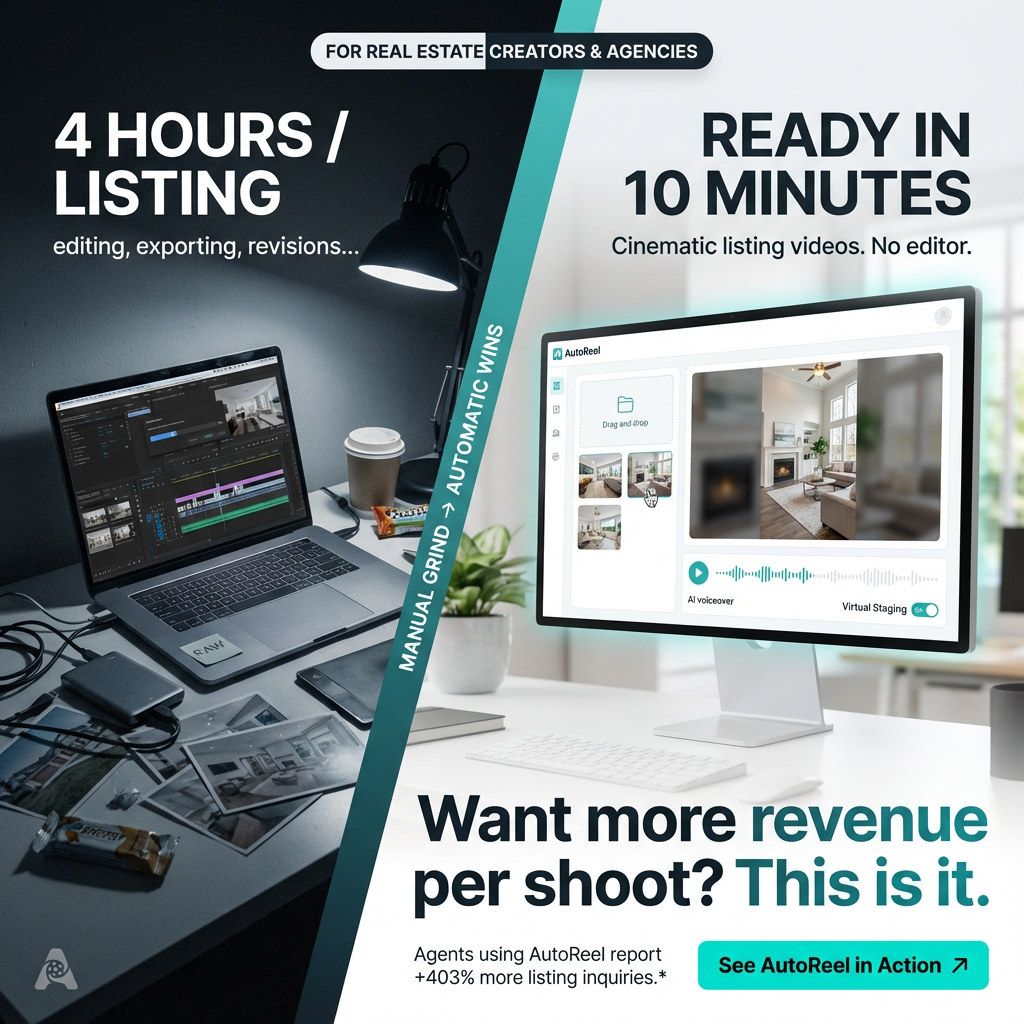
If you’re a real estate media company, these trends redefine service offerings.
Clients now expect:
- Video included
- Virtual staging options
- Social-ready content
- Fast turnaround
- Branded templates
Media houses using AI-assisted production tools can:
- Increase margins
- Reduce editing hours
- Serve more agents
- Deliver consistent quality
Efficiency becomes profit.
To see how production teams are operationalizing this shift, explore why realtors are choosing AI video platforms to scale content faster.
How to Adapt Without Overwhelming Your Workflow
You don’t need a full production team.
Start with:
- Turning every listing into a short-form video
Note: If you're unsure where to start, this step-by-step real estate video marketing implementation guide breaks down the exact system agents are using today.
- Using AI virtual staging for vacant homes
- Exporting multi-format versions automatically
- Adding consistent branding elements
- Posting within 24 hours of listing launch
Scalable tools now allow agents and teams to stage, enhance, and convert listings into videos from a single platform — removing the tech friction that used to slow social execution.
That’s the difference between knowing trends and applying them.
Final Thoughts

The biggest shift in real estate social media marketing trends is simple:
Marketing is becoming faster, smarter, and more video-driven.
Agents who:
- Embrace AI tools
- Prioritize short-form video
- Maintain consistent branding
- Launch listings quickly
… will dominate attention.
The market is not slowing down — it’s speeding up.
If you're evaluating tools to simplify this process, you can explore how AutoReel works or reach out directly to discuss your workflow needs.
And in 2026, visibility belongs to the agents who move first.
Frequently Asked Questions
1. What are the most important real estate social media marketing trends in 2026?
Short-form video, AI-powered editing, virtual staging, personal branding, and fast turnaround workflows are leading trends. Agents who prioritize video and automation see stronger engagement and listing visibility.
2. How can realtors use AI in social media marketing?
AI can generate listing videos, enhance property photos, add voiceovers, create captions, and virtually stage empty rooms. This reduces production time and increases content output without expanding teams.
3. Why is video better than static photos for real estate marketing?
Video captures attention longer, performs better in algorithms, and allows storytelling. It creates emotional engagement that static images often cannot.
4. What social media platforms should real estate agents focus on?
Instagram Reels, YouTube Shorts, Facebook, and TikTok are high-impact platforms. Content should be optimized as per the platform rather than duplicated blindly.
5. How often should realtors post on social media?
Consistency matters more than frequency. 3–5 quality posts weekly, including listing videos and educational content, is effective for most markets.
6. Is virtual staging worth it for social media marketing?
Yes, virtually staged listings receive higher engagement because they help buyers visualize potential. When combined with video, results improve further.
7. How can real estate media houses scale social video production?
By using AI-driven photo-to-video tools, automated formatting, and template-based branding systems, media houses can handle higher listing volumes without increasing labor costs.
Sources:
https://www.nar.realtor/research-and-statistics/research-reports/profile-of-home-staging
https://www.hubspot.com/state-of-marketing
https://www.zillow.com/research/20-years-housing-data-36049/
Image Sources:
Image 2:
<a href="https://www.freepik.com/free-vector/social-media-marketing-phone-design_6600487.htm">Image by freepik</a>
Image 6:
<a href="https://www.freepik.com/free-vector/house-searching-concept-landing-page_5614074.htm">Image by freepik</a>
Image 7:
<a href="https://www.freepik.com/free-vector/influencer-concept-landing-page_5337073.htm">Image by pikisuperstar on Freepik</a>