Emerging Real Estate Video Marketing Trends for 2026

Summarize with AI


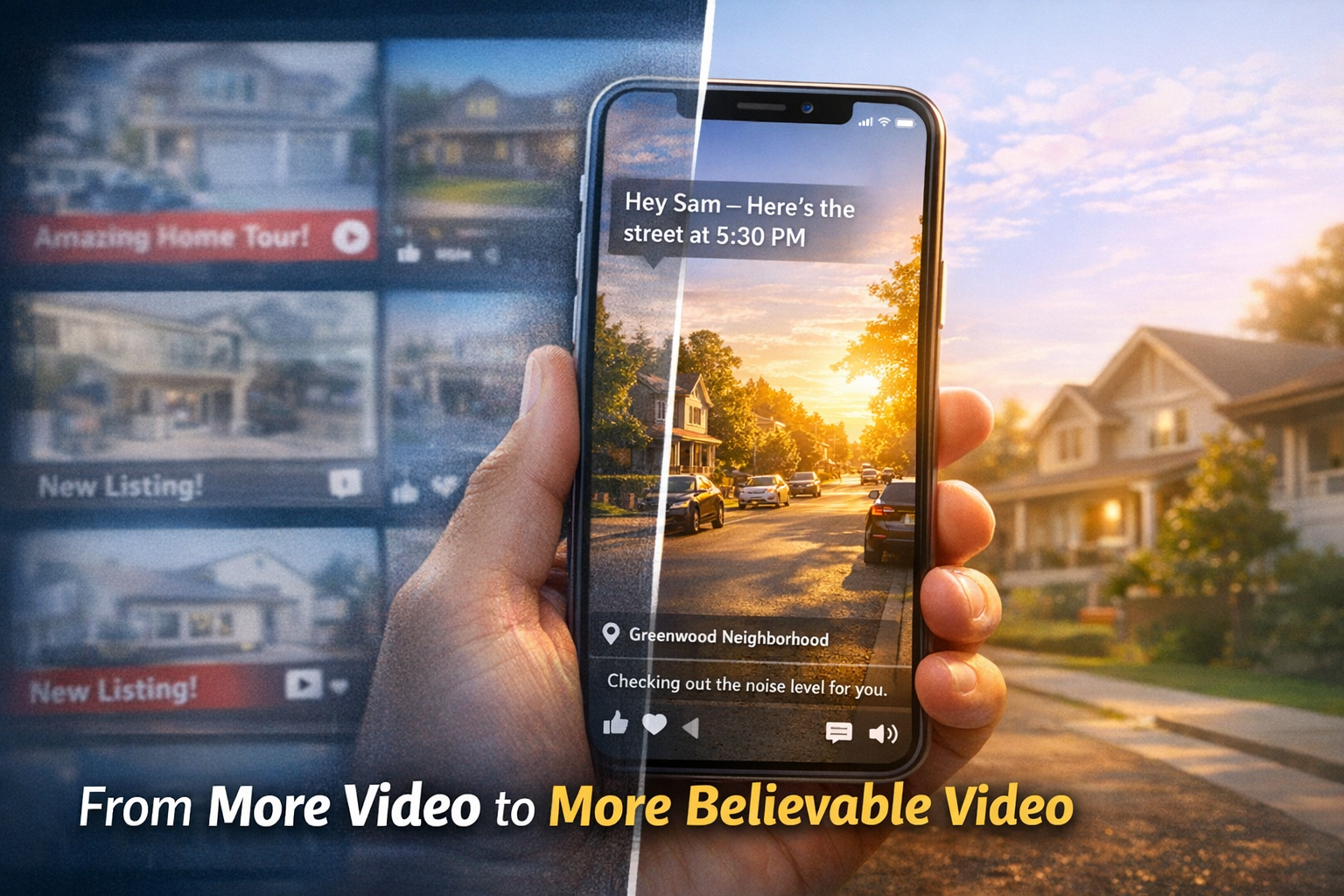
If 2024–2025 was the era of more video, 2026 is shaping up to be the era of more believable video.
Two things are happening at once:
- Social platforms keep pushing video-first distribution (short-form still wins attention).
- AI makes production easier than ever… which also makes low-quality, misleading, or generic content easier than ever. That trust gap is becoming visible, especially in real estate, where the stakes are huge.
If you want the data behind this shift, here’s a deeper breakdown of how property videos change buyer behavior and inquiry volume.
So the teams that win in 2026 will not be the ones that only post the most. They’ll be the ones whose personalized video content feels accurate, local, and human — while still being fast enough to keep up.
Real estate video marketing trends 2026 are centered on credibility and speed, where real estate video trends prioritize short, authentic formats. AI real estate marketing trends 2026 and AutoReel latest solutions enable scalable production while supporting real estate marketing trends 2026 focused on transparency, personalization, and buyer trust.
12 Emerging Real Estate Video Marketing Trends For 2026
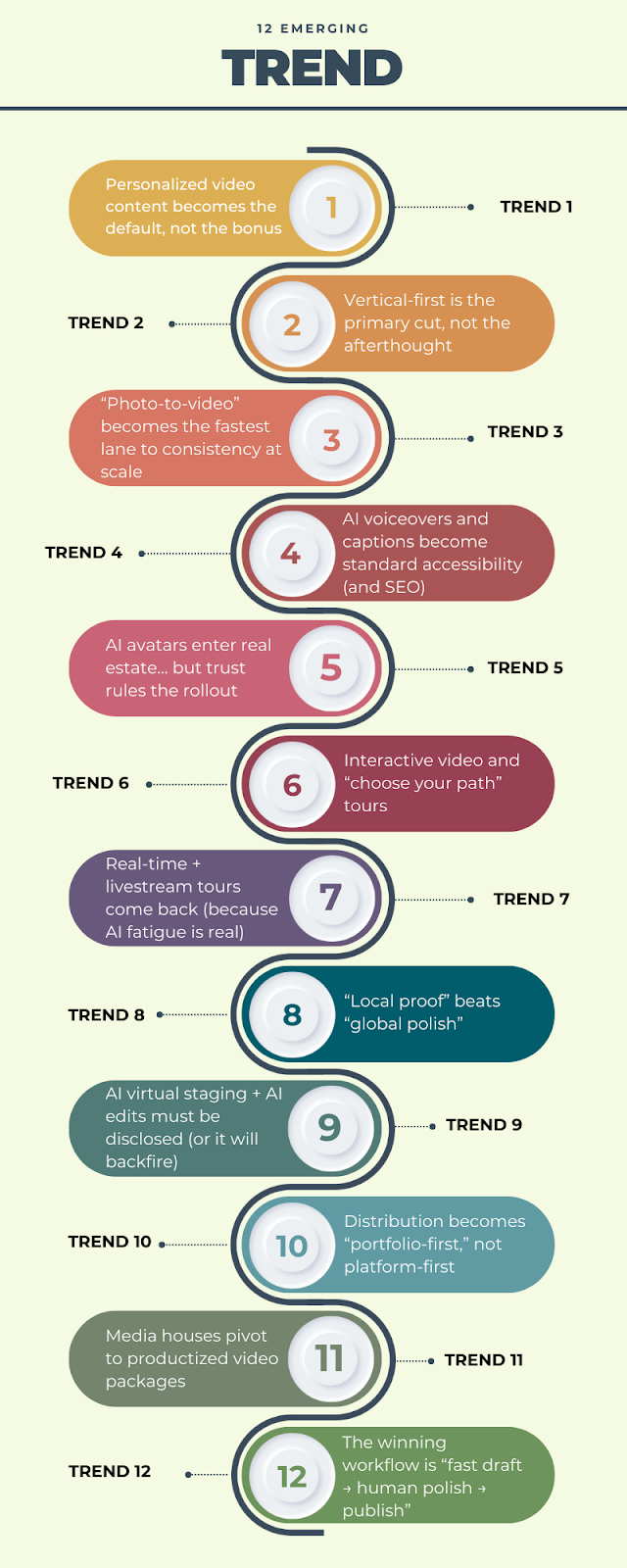
Below is the “skyscraper” part — more complete than typical trend lists, with practical implications for agents and media houses.
Trend 1: Personalized video content becomes the default, not the bonus
The most effective videos in 2026 will be specific:
- “Hey Sam, you asked about noise—here’s the street at 5:30 pm.”
- “Here’s what $650K buys in this school zone versus two blocks over.”
- “Here are three homes like yours that sold this month, and why.”
This is a shift from “broadcast” to “narrowcast.” Tools that help you spin one base asset into many versions are predicted to grow in importance.
What to do now: build reusable scripts (15–30 seconds) for 5–10 common questions and personalize the hook.
Trend 2: Vertical-first is the primary cut, not the afterthought
Real estate content is being consumed where thumbs live. Some AI video tools are even updating specifically for vertical workflows.
What to do now: create a vertical template set (listing highlight, neighborhood highlights, “3 reasons this home is different,” price drop update, open house teaser).
If you’re building those templates, start with frameworks that already work for listing highlights and short-form hooks.
Trend 3: “Photo-to-video” becomes the fastest lane to consistency at scale

This is the big operational unlock: take listing photos and generate a clean, cinematic reel quickly — especially for teams managing a lot of inventory. AutoReel explicitly positions itself as turning property photos into videos “100x faster,” and offers both portrait and landscape outputs.
What to do now: treat listing photos as a content source file (not a dead asset). Every listing gets at least 3 video outputs:
- 30–60 sec highlights
- 15 sec hook teaser
- “Feature spotlight” micro-video (kitchen, view, backyard, etc.)
If you’re comparing options, this guide breaks down the best platforms and what to look for in a real estate-focused workflow. The AutoReel latest updates focus heavily on speed and vertical output.
Trend 4: AI voiceovers and captions become standard accessibility (and SEO)
- Captions aren’t optional — many viewers watch muted.
- AI voiceovers work best when the script stays hyper-specific to the home and the buyer question you’re answering.
AutoReel includes AI voiceovers and platform-optimized captions as built-in features.
What to do now: always publish with captions; use voiceover for consistency, but keep it accurate and disclosure-friendly.
Trend 5: AI avatars enter real estate… but trust rules the rollout
AI avatars are growing across industries for personalization and scale, and 2026 trend forecasts highlight momentum here.
AutoReel also offers “AI Avatars” for a more personal presentation format.
Reality check: avatars can feel polished, but if they feel fake or overused, they can lower trust. Use them where they make sense:
- Quick listing intros
- Market update series
- Multilingual versions (with careful review)
Here’s how real estate teams are using avatars and voiceovers without losing the human feel.
Trend 6: Interactive video and “choose your path” tours
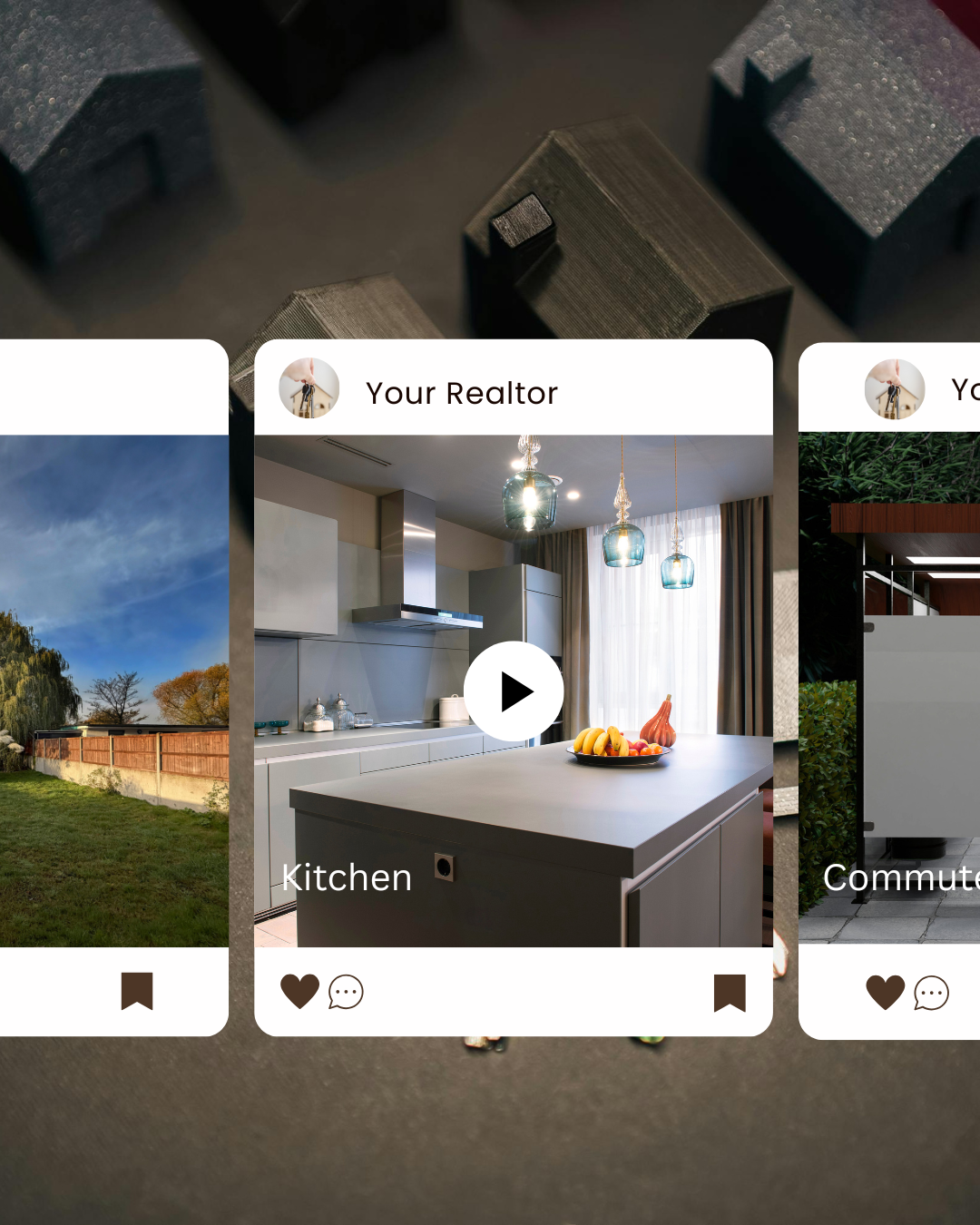
People want control:
- “Tap to see the primary suite”
- “Choose backyard vs. kitchen”
- “Select commute route A vs. B”
This isn’t just fancy tech — it’s a way to reduce wasted showings by qualifying buyers faster.
What to do now: structure videos in chapters (even if the platform doesn’t support true branching, you can simulate it with chapters, pinned comments, or multiple clips).
Trend 7: Real-time + livestream tours come back (because AI fatigue is real)
Longer formats and livestreams are gaining momentum again in 2026 predictions.And video-first listing platforms are leaning into livestream and interactive tour behavior. Live formats are reshaping real estate video trends in 2026.
What to do now: do one weekly livestream:
- “New listings this week in [Neighborhood]”
- “Ask me anything about buying in 2026”
Clip it into 5–10 shorts afterward.
Trend 8: “Local proof” beats “global polish”

Neighborhood micro-content wins:
- Parking reality
- School pickup traffic
- Coffee shop noise level
- Flood risk context
- Seasonal light in the living room
This is where personalized video content becomes defensible: it’s hard for generic competitors to copy. Hyperlocal proof is becoming a defining factor in real estate marketing trends 2026.
Trend 9: AI virtual staging + AI edits must be disclosed (or it will backfire)
AI staging and enhancements can help, and AutoReel lists AI virtual staging and AI photo edits as features.But the industry is also seeing backlash and credibility issues when AI creates misleading impressions.
What to do now: adopt a disclosure line in descriptions:
- “Some visuals may be virtually staged or AI-enhanced for presentation.”
Transparency is becoming essential as ai real estate marketing trends 2026 expand.
And keep an archive of originals.
If you want a clean, buyer-friendly way to explain the difference between staging and editing, start here.
Trend 10: Distribution becomes “portfolio-first,” not platform-first
Multi-platform publishing is central to real estate video marketing trends 2026, not an optional extra. In 2026, you want a content portfolio:
- YouTube (search + long shelf life)
- Shorts/Reels/TikTok (reach)
- LinkedIn (credibility, recruiting, investors)
- Website blog embeds (SEO and conversion)
AutoReel notes captions optimized for multiple platforms, which aligns with this multi-channel approach.
Trend 11: Media houses pivot to productized video packages
For real estate media houses, the growth model is:
- Predictable deliverables
- Predictable turnaround times
- Templates + brand systems
- AI assistance to protect margins
AutoReel positions itself for media companies to “scale… with AI property videos — no extra overhead.”
Trend 12: The winning workflow is “fast draft → human polish → publish”
2026 is not “AI replaces creators.” It’s “AI removes the lengthy parts.”
This balance defines ai real estate marketing trends 2026 - efficiency with human oversight.
Example: generate a first cut fast, then add:
- Accurate feature callouts
- Neighborhood nuance
- Compliance disclosures
- Your brand tone
Even AI toolmakers are moving toward more controllable editing to reduce wasted regenerations — basically acknowledging that human direction still matters.
That’s also why platforms are investing in more realistic motion and better base outputs.
What This Means For Real Estate Agents (A Practical Playbook)

Your weekly “video operating system” (simple, repeatable)
3 listing videos/week
- 1 highlight reel (30–60 sec)
- 1 feature spotlight (15–25 sec)
- 1 “context” clip (neighborhood, commute, buyer Q&A)
2 relationship videos/week (personalized video content)
- Video text reply to a lead question
- “I found 3 options for you” shortlist walkthrough
1 authority video/week
- 60–90 sec market update (inventory, rates, seasonality, buyer behavior)
Why this works in 2026: it balances speed (AI-generated videos + templates) with trust (human context + personalization).
What This Means For Real Estate Video Trends 2026 Impacting the Media Houses (A Scale Playbook)
Productize your offers
Create 3 packages:
Listing reel pack
- 3 short videos per listing (teaser, highlight, feature spotlight)
Agent brand pack
- 4 avatar or on-camera videos/month (market updates, FAQs, “how to buy”)
Community content pack
- 4 neighborhood reels/month (events, lifestyle, “moving to…”)
AutoReel’s positioning toward media companies + its studio customization features (templates, branding, music, captions) fit the productization model.
Margin protection rule
If your profit depends on manual editing hours, you’re exposed. If it depends on systems, you’re durable.
How to Evaluate an AI Real Estate Video Editor Trend 2026 (Decision Checklist)
A good AI video editor is less about flashy effects and more about repeatability—templates, brand controls, and clean exports.
Use this when comparing tools (or vetting AutoReel internally):
- Speed & workflow
- Brand control
- Distribution support
- Trust and accuracy
- Scale features
Why AutoReel is better for your business for Real Estate Video Marketing Trends 2026
If you’re choosing a platform for 2026, the core question is simple:
Can it help you create trustworthy, on-brand video at the speed the market demands?
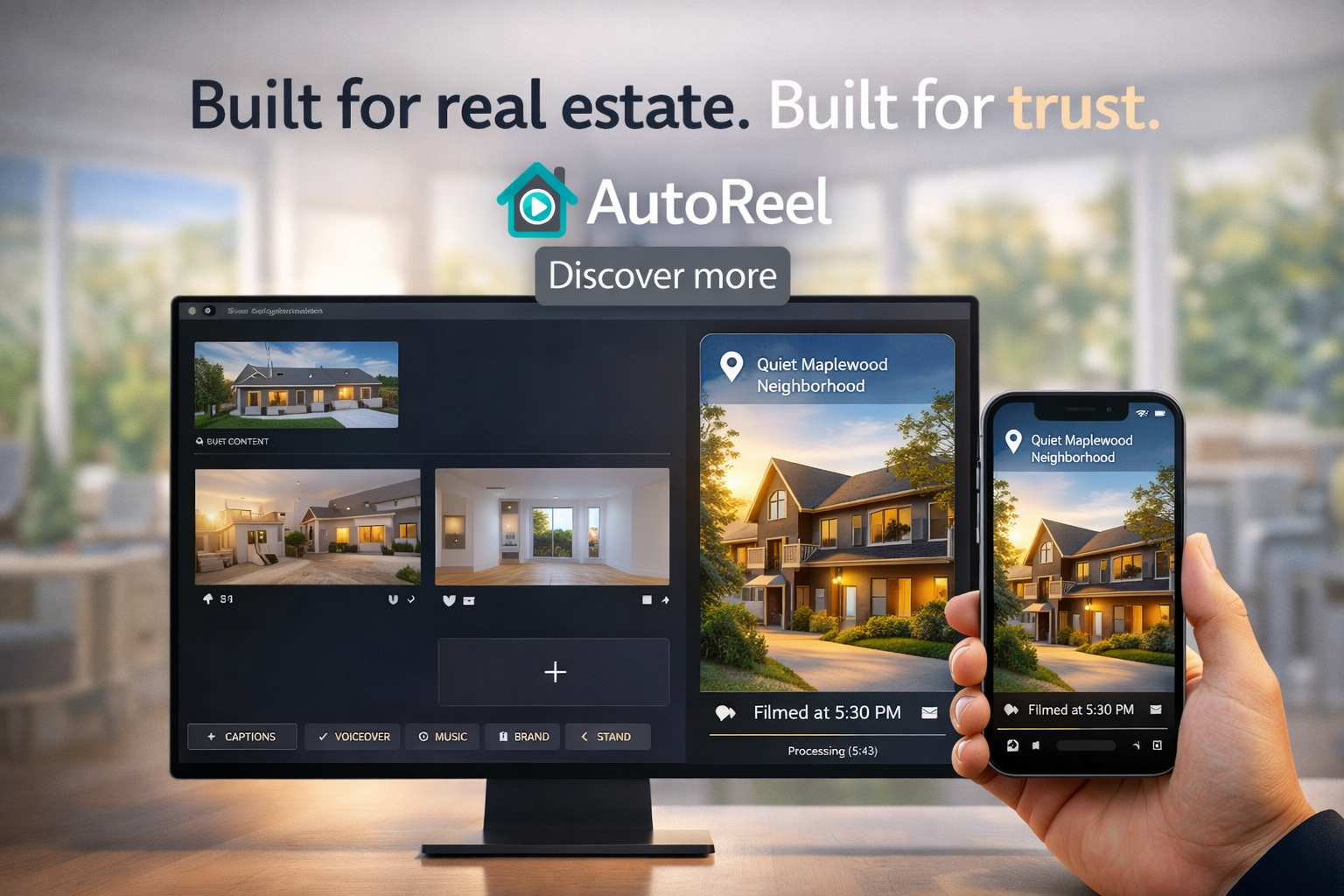
AutoReel is built specifically for real estate and emphasizes fast creation from photos, with a workflow designed for both agents and media companies.
Bottom line: AutoReel aligns with the biggest 2026 reality — you need more personalized video content, delivered faster, without sacrificing credibility.
If you want a quick recommendation based on your workflow, reach out and we’ll point you to the right setup.
FAQs
1) What is personalized video content in real estate?
Personalized video content is video tailored to one person or a tight audience segment. It references their exact question, budget, neighborhood, timeline, or concerns, so it feels like a direct conversation—not a generic listing promo—and usually converts faster.
2) Will AI-generated videos replace real estate videographers in 2026?
AI-generated videos will not replace videographers completely. AI is ideal for fast drafts, everyday listings, and high-volume production. Skilled videographers still win for luxury homes, brand films, cinematic storytelling, and creative direction that protects accuracy.
3) What is the biggest real estate video trend for 2026?
The biggest 2026 trend is trust-driven personalization. Short-form is still powerful, but audiences are tired of generic, overly polished content. Agents who add local proof, real context, and personalized hooks will outperform high-volume posting.
4) How do agents use personalized video content without spending hours editing?
Start with a photo-to-video draft, then personalize the first few seconds: say the lead’s name, reference their question, and mention a local detail. Keep edits minimal, add captions, and end with one clear next step or CTA.
5) Are AI avatars good for real estate marketing?
AI avatars can work for consistent market updates, multilingual versions, and “always-on” content when you cannot be on camera. Use them sparingly and keep messaging specific. If avatars feel generic or misleading, they can reduce trust.
6) Do I need to disclose virtual staging or AI enhancements?
Yes, disclosures are strongly recommended, especially for virtual staging or AI-enhanced visuals. Real estate audiences are increasingly sensitive to misleading edits. Clear disclosure protects credibility, reduces confusion, and helps avoid negative engagement signals over time.
7) What platforms matter most for real estate video in 2026?
Use a portfolio approach. Reels, Shorts, and TikTok drive reach and discovery. YouTube supports long-term search visibility and higher-intent viewers. LinkedIn builds credibility, referrals, and recruiting. Repurpose the same core video across formats and channels.
8) How fast can AutoReel create a video?
Using AutoReel, videos are typically ready within 10–15 minutes, though processing can take longer during peak times. The goal is rapid creation from listing photos, plus tools like captions and voiceovers to speed up posting across platforms.
9) What are the key real estate video marketing trends 2026?
Real estate video marketing trends 2026 focus on short vertical content, authenticity, and speed. AI real estate marketing trends 2026 improve editing and captions, while real estate video trends emphasize mobile-first, neighborhood insights, and consistent publishing.
10) How does AutoReel latest reflect real estate marketing trends 2026?
AutoReel latest supports real estate marketing trends 2026 by enabling fast photo-to-video creation, vertical formats, and AI captions. These real estate video trends help agents stay visible, efficient, and competitive across modern social platforms.
Sources:
https://sproutvideo.com/blog/top-2026-video-trends-and-predictions.html
https://www.theverge.com/news/774352/google-veo-3-ai-vertical-video-1080p-support
https://flippingbook.com/blog/marketing-tips/real-estate-marketing-trends
https://nypost.com/2025/10/29/real-estate/real-estate-execs-launch-klipster-for-securing-a-home/
https://que.com/trending-real-estate-video-strategies-predicted-to-succeed-in-2026/
https://www.virtuance.com/blog/real-estate-marketing-trends-strategies-2026/