How Solo Realtors Are Scaling Faster With AI-Driven Real Estate Video Marketing in 2026

Summarize with AI


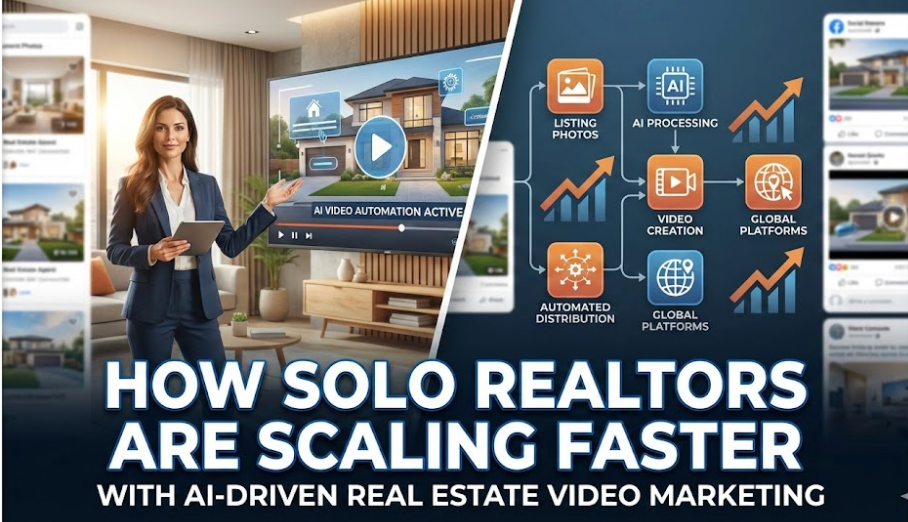
Real estate video marketing has become a structural requirement for solo realtors as buyer attention shortens, seller expectations rise, and platforms favor motion-based content over static images. Until recently, consistent execution remained difficult due to production costs and dependence on external vendors.
What’s changing is deployment reliability. This article explains how AI for realtors and automated marketing tasks for realtors enable standardized real estate video marketing across listings without added headcount, operational complexity, or increased marketing expense.
What You’ll Learn From This Breakdown
- The structural role of real estate video marketing for solo agents
- How production and distribution constraints shape execution consistency
- The cost dynamics that determine whether video is scalable
- Where AI for realtors and automated marketing tasks create operational leverage
- How visual parity with larger teams is achieved in practice
These points help frame how pricing, usage limits, and ROI are evaluated in practical terms.
AutoReel pricing outlines how these plan structures and usage considerations are defined.
What Real Estate Video Marketing Looks Like for Solo Realtors
Real estate video marketing for solo realtors now functions as a core listing asset rather than a promotional add-on. It directly influences how listings are surfaced, evaluated, and compared across digital platforms. For independent agents, understanding how real estate video marketing operates at a practical level is essential to maintaining competitive credibility.
Functional scope of real estate video marketing
Real estate video marketing includes short, property-focused video assets that support listing promotion, buyer engagement, and ongoing brand visibility. For solo realtors, this typically includes:
- Listing presentation videos
- Property highlight sequences
- Platform-optimized social clips
The objective is not cinematic production. The focus is spatial clarity, visual continuity, and faster buyer comprehension during early-stage evaluation.
Market-driven expectation shift
Buyer behavior increasingly favors motion-based content, and platforms amplify video visibility even without transparent algorithms. Sellers have adapted, and listings are now evaluated on whether video is present, not just intended. Inconsistent real estate video marketing creates perception gaps, signaling limited operational readiness regardless of experience.
The consistency deficit
Historically, real estate video marketing for solo realtors suffered from high costs, scheduling friction, and unreliable output. As expectations increased, reliability became more important than creative variation. Today, real estate video marketing is defined by consistent inclusion across inventory, a shift increasingly supported by AI for realtors and automated marketing tasks for realtors.
Why Real Estate Video Marketing Has Always Been Hard for Independent Agents
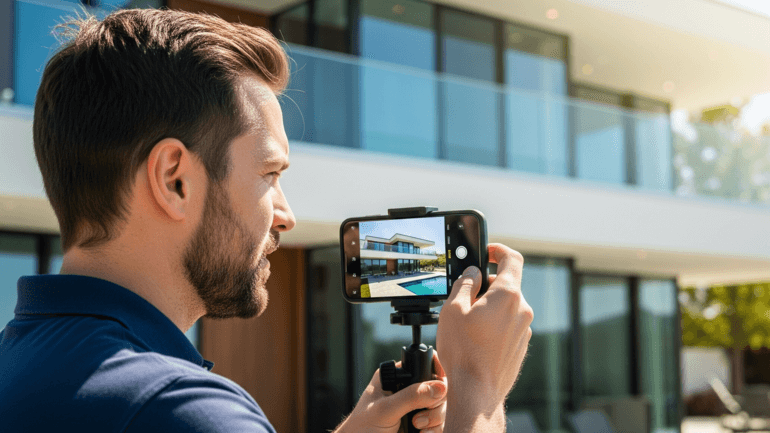
Real estate video marketing has historically placed independent agents at a structural disadvantage. As demand increased, production and distribution systems were built for teams, vendors, and larger budgets rather than solo execution. The issue was never intent. Expectations rose faster than the ability to execute consistently, making real estate video marketing difficult to sustain under traditional models.
Cost structure limitations
Traditional real estate video marketing carried high per-listing costs. Professional videography, editing, and revisions often ranged from hundreds to thousands of dollars. For solo realtors with variable income, this forced selective use, limiting video to premium listings instead of consistent inventory-wide deployment.
Production latency
Scheduling photographers, coordinating sellers, and waiting on post-production slowed release timelines. Listings frequently went live before videos were ready, causing early buyer momentum to pass and reducing the overall effectiveness of real estate video marketing.
Operational dependency
Even small revisions required external turnaround, keeping agents dependent on vendors rather than controlling timelines internally.
These constraints led to predictable outcomes:
- Video reserved for premium inventory
- Inconsistent social publishing
- Reduced leverage during listing presentations
Only about 20 percent of real estate photography orders include video, reflecting structural barriers rather than lack of interest. As a result, real estate video marketing became associated with friction instead of scalability for independent agents.
This is the gap AutoReel was designed to close for solo agents.
How AI for Realtors Removes the Friction From Video Creation
AI for realtors, like AutoReel, has changed how listing videos are produced by removing manual production steps that previously slowed output. Instead of relying on filming, editing, and external coordination, video creation now begins directly from existing listing photography.
This shift reduces physical production dependency and shortens the time required to generate usable assets for real estate video marketing. Faster production impacts adoption more than incremental quality improvements, allowing video to fit naturally into listing workflows.
Key changes enabled by AI for realtors
- Converts listing photos into motion-based video without manual editing
- Automatically generates sequencing, pacing, and transitions
- Eliminates filming logistics while preserving visual consistency
- Produces 30-second videos in approximately 10 to 15 minutes
- Allows video creation to align with listing activation timing
- Reduces delays during busy listing periods
- Retains agent control over imagery, messaging, and branding
- Uses automation for structure, not narrative intent
As a result, real estate video marketing shifts from manual production friction to a controlled, repeatable process that scales without increasing production overhead.
This is the production layer where AutoReel fundamentally changes the timeline.

Which Automated Marketing Tasks for Realtors Can Now Be Handled for You
Real estate video marketing extends beyond video creation into distribution and execution. For solo agents managing multiple listings, formatting, publishing, and coordination historically required significant manual effort.
Automated marketing tasks for realtors now address this execution layer directly, removing repetitive actions that previously slowed publishing and reduced consistency across channels.
Distribution and formatting overhead
Once a video asset is available, it must be adapted for multiple platforms. Aspect ratios, file sizes, and placement requirements vary across listing portals and social networks.
Without automation, real estate video marketing required manual resizing, exporting, and version management. Automated marketing tasks for realtors now handle these variations, ensuring each video conforms to platform-specific standards without additional processing time.
Execution-level automation
Execution-level automation focuses on how video assets are deployed rather than how they are created. Automated marketing tasks for realtors manage distribution mechanics with accuracy and repeatability.
Automated marketing tasks for realtors now manage:
- Aspect ratio adaptation across listing portals and social platforms
- Platform-specific video formatting to meet distribution requirements
- Caption standardization and metadata reuse for consistent publishing
- File optimization to reduce upload errors and processing delays
- Scheduling alignment to maintain predictable real estate video marketing output
Consistent execution removes friction from publishing. When automated marketing tasks for realtors handle distribution, real estate video marketing maintains predictable visibility across channels without increasing workload for solo agents.
This is where AutoReel removes the repetitive work that slows distribution.
How Solo Realtors Use Real Estate Video Marketing Without Hiring Help
Solo realtors can increasingly expand real estate video marketing output without adding staff or external coordination. The change is driven by cost structure shifts and predictable access to video across listings, not by increased workload.
As a result, video usage is no longer tied to team size or internal resources.
Standardized video deployment
Real estate video marketing is now applied uniformly across listings rather than reserved for select properties. Solo agents can include video as part of the default listing presentation, rather than treating it as a premium add-on.
This standardization improves baseline listing quality and ensures consistent visual coverage across property prices and market segments.
Cost mechanics
The economics of real estate video marketing have shifted significantly. Photographers can generate AI-based listing videos at approximately $10 per unit and sell them for $80 or more. Some command rates up to $300 due to visual parity with traditionally filmed footage.
For solo realtors, this pricing structure lowers adoption barriers while keeping per-listing marketing costs predictable and manageable.
Resulting advantages
Consistent application of real estate video marketing produces tangible outcomes:
- Uniform listing presentation across the full inventory
- Persistent social visibility without additional staffing
- Improved seller confidence during listing evaluations
- Reduced reliance on external production resources
These outcomes allow solo agents to scale video usage without increasing headcount.
As video becomes economically viable at volume, real estate video marketing shifts from a discretionary expense to a standard operating component for independent agents. These outcomes reflect how cost structure influences adoption at scale.
What Real Estate Video Marketing Means When Competing With Larger Teams
Real estate video marketing has historically favored brokerages and teams with dedicated marketing resources. Larger organizations deployed video more frequently, creating visible gaps in listing presentation and market presence.
For solo realtors, this imbalance shaped how listings were compared and how sellers judged marketing capability. In competitive environments, visual consistency often acted as a proxy for operational strength rather than experience or results.
Historical imbalance
Large teams benefited from in-house marketers, agencies, and higher production capacity. Video creation and publishing were supported by staff instead of being constrained by individual bandwidth.
As a result, real estate video marketing became associated with organizational scale rather than execution discipline. Independent agents were judged on visual output, regardless of market knowledge or performance.
Structural correction
Changes in how video is produced and distributed have reduced the advantages tied to headcount. Output is no longer dependent on internal marketing departments.
AutoReel has supported the creation of 85,000 AI real estate videos as of December 2025, primarily produced by independent agents and photographers operating without teams. This reflects broader access to video capability.
Competitive implication
Visual consistency no longer signals organizational size. Solo agents can now match larger teams in frequency and baseline quality.
Real estate video marketing increasingly functions as a neutral competitive surface, where listings are evaluated on clarity and presentation rather than organizational scale.
This competitive shift is already visible in how AutoReel is being adopted.

The Shift From Capability Gaps to Execution Control
Real estate video marketing has historically exposed the gap between independent agents and larger teams. The limitation was never the video’s value, but the ability to execute consistently within traditional production and distribution models.
AI for realtors removes production constraints, while automated marketing tasks for realtors eliminate distribution inefficiencies. Together, they enable real estate video marketing to operate as a standardized component, with consistency and presentation quality governed by process efficiency rather than manpower.
AutoReel pricing provides a reference point for evaluating the economics discussed here.
Key Market Insights
- Execution consistency now outweighs production quality in real estate video marketing
- AI for realtors has shifted video from a premium add-on to a baseline expectation
- Automated marketing tasks matter most after creation, where distribution friction exists
These patterns are increasingly referenced in discussions around real estate marketing scalability and AI adoption.
FAQs
1. Why has real estate video marketing become mandatory for solo realtors?
Real estate video marketing is now expected in listing presentations. AI for realtors reduces production friction, while automated marketing tasks for realtors ensure consistent publishing. Together, these systems help solo agents meet attention standards and seller expectations without expanding teams.
2. How does AI for realtors change the economics of video production?
AI for realtors reshapes real estate video marketing economics by removing videography and editing dependencies. Automated marketing tasks for realtors lower execution overhead, enabling solo agents to scale video output, control per listing costs, and deploy assets without higher costs.
3. Are AI-generated videos suitable for high-value listings?
Real estate video marketing using AI for realtors suits high value listings because buyers prioritize clarity and pacing over capture method. Automated marketing tasks for realtors ensure consistent distribution, preserving presentation standards and maintaining professional perception across premium property portfolios.
4. What automated marketing tasks for realtors have the highest operational impact?
Automated marketing tasks for realtors create the highest impact by eliminating manual resizing, formatting, and posting. Within real estate video marketing, AI for realtors handles production while automation stabilizes distribution cadence, reduces execution errors, and helps solo agents maintain visibility.
5. Can real estate video marketing be standardized across all listings?
Yes, real estate video marketing can be standardized when AI for realtors removes cost and timing constraints. Automated marketing tasks for realtors enable uniform deployment across inventory, ensuring every listing receives video coverage, consistent branding, and exposure regardless of pricing.
6. How fast can AI-based real estate videos be produced?
AI for realtors accelerates real estate video marketing by compressing production timelines. Videos are generated quickly, enabling realtors to automate marketing tasks and publish assets quickly, preserve listing freshness, and align video releases with initial market entry for active listings.
7. Does automation reduce control over branding and messaging?
No, AI for realtors does not reduce brand control within real estate video marketing. Agents define visuals and messaging, while automated marketing tasks for realtors execute, maintain compliance standards, and ensure consistent presentation across digital channels without manual intervention.
8. How does video consistency affect seller confidence?
Consistent real estate video marketing strengthens seller confidence by signaling preparation and capability. AI for realtors enables timely production, while automated marketing tasks for realtors ensure uniform distribution, leading sellers to perceive lower risk and stronger commitment throughout listing campaigns.
9. Is AI-based video marketing dependent on social media algorithms?
Real estate video marketing supported by AI for realtors is not dependent solely on social media algorithms. Automated marketing tasks for realtors enable distribution across listings, presentations, and email, reducing platform risk while maintaining consistent exposure throughout the property lifecycle.
External References
- National Association of Realtors (NAR)Video Marketing and Digital Media Trends in Real Estatehttps://www.nar.realtor
- HubSpot Marketing StatisticsVideo Marketing Adoption and Performance Benchmarkshttps://www.hubspot.com/marketing-statistics
- Reddit – r/realtorsDiscussion: Is video actually worth it for solo agents?https://www.reddit.com/r/realtors/
- Reddit – r/RealEstatePhotographyThread: AI video tools and pricing models for photographershttps://www.reddit.com/r/RealEstatePhotography/
- YouTube – Real Estate Marketing ChannelHow short-form listing videos outperform photos on social platformshttps://www.youtube.com/results?search_query=real+estate+video+marketing