How to Break Into Real Estate Photography Faster With AI Video Tools

Summarize with AI


Takeaway
- Learn how AI video helps new photographers enter markets faster.
- Understand how to offer video without filming or extra gear.
- See how simple video add-ons increase value and competitiveness.
Breaking into real estate photography today is less about learning the craft and more about aligning with how listings are marketed right now.
For photographers who already understand real estate workflows, the challenge is not technical competence but market entry. Agents increasingly expect visual packages that include some form of video, even at the entry level.
This guide focuses on how to break into real estate photography using AI video tools from a practical standpoint. It does not cover photography basics or general business setup.
Instead, it examines how AI-generated video fits into an existing photography workflow, how it lowers common entry barriers, and how it helps newer photographers present more complete, competitive offerings earlier in their careers.
See how AutoReel helps photographers enter markets faster with video
Why Video Is the Fastest Way to Break Into Real Estate Photography Today
Video has shifted from a premium extra to a common expectation in many real estate markets.
This shift is not driven by cinematic standards but by distribution habits. Listings are marketed across social platforms, messaging apps, and listing portals where motion consistently draws more attention than still images alone.
For photographers trying to enter the market, this has direct implications. Agents evaluating new vendors often look for signs that a photographer understands marketing, not just image quality. Video acts as a proxy for that understanding.
From an entry perspective, video helps in several ways:
- It signals completeness in a service offering
- It reduces the perceived gap between new and established photographers
- It aligns photography services with how agents promote listings
Importantly, most agents are not evaluating technical video quality in depth. They are assessing whether the content is usable, timely, and appropriate for their channels. This lowers the threshold for entry while raising the importance of simply having video available.
Because of this, photographers who can include video early tend to access conversations and opportunities that still-only providers miss. Video does not guarantee success, but its absence increasingly creates friction at the entry stage.
The Real Barriers Holding Photographers Back
Despite clear demand, many photographers delay offering video due to structural barriers rather than lack of awareness. These barriers are practical and understandable, especially for those entering a new market.
The most common constraints include:
- Time required to learn video editing workflows
- Cost of additional equipment such as stabilizers or drones
- Mental overhead of managing another deliverable
For a photographer still building a client base, these costs feel disproportionate. Investing heavily before revenue stabilizes introduces risk, particularly when video production is not yet guaranteed to convert into consistent sales.

As a result, many photographers adopt a cautious approach. They enter the market with still photography only, planning to add video later. In practice, later often never arrives because client acquisition itself becomes harder without video.
This creates a damaging cycle:
- Limited offerings reduce competitiveness
- Reduced competitiveness slows client acquisition
- Slower acquisition delays service expansion
The issue is not unwillingness to adapt. It is the mismatch between upfront investment and uncertain return. Any solution that helps address this mismatch has a direct impact on how quickly a photographer can establish themselves.
How AI Video Tools Support Market Entry Without Video Production
AI video tools change what it means to offer video in real estate photography.
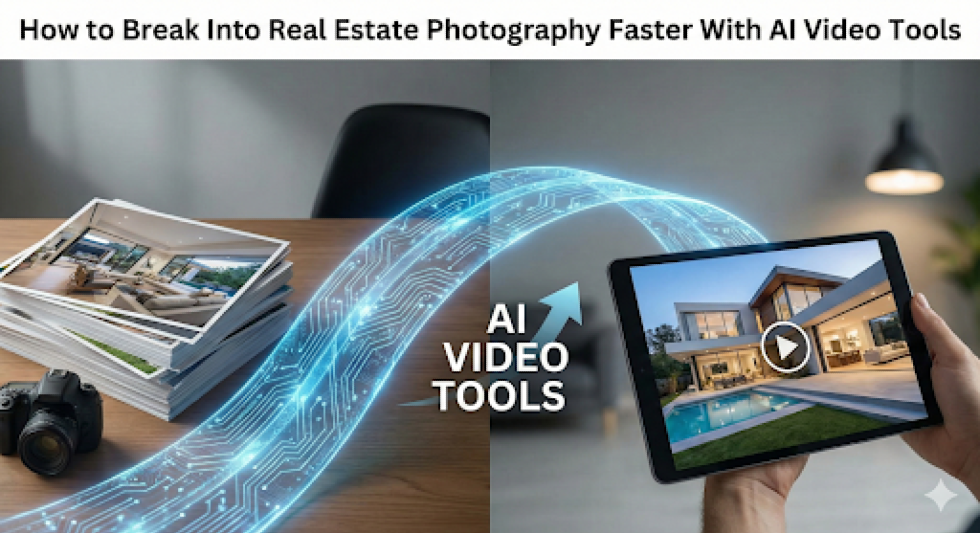
Instead of capturing motion on site, photographers create short videos using the listing photos they already produce. This shifts video from a production-heavy service to a post-processing step that fits naturally into existing workflows.
In practice, the process looks like this:
- Final edited listing photos are uploaded
- Automated motion, transitions, and timing are applied
- Short marketing videos are exported for delivery
This model aligns closely with how most real estate video is actually used.
The majority of listing videos are brief, visually driven, and designed for online platforms rather than long-form storytelling. Agents typically prioritize speed, consistency, and ease of sharing over complex production.
To clarify why this matters for market entry, the difference between traditional video and AI video is best viewed side by side:
For photographers entering the market, AI video tools offer clear advantages:
- No change to the on-site shooting process
- Predictable and fast production timelines
- Consistent output across multiple listings
AI-generated video does not replace full videography. It serves a different role.
For entry-level and mid-tier listings, it meets functional expectations while allowing photographers to focus on client acquisition, delivery reliability, and pricing strategy. This makes it a practical way to break into real estate photography without expanding the skill stack too early.
How AutoReel Fits Into Existing Photography Workflow
AutoReel is generally used as a post-production step rather than a separate service layer.
Photographers apply it after a standard photo shoot and editing process is complete, which keeps the core workflow intact. There is no need to plan additional on-site work or alter how listings are captured.
In practice, the workflow is simple and repeatable:
- Final listing photos are uploaded
- Short videos are generated from those images
- Videos are delivered alongside still photography
This approach preserves continuity. Shoots are scheduled the same way, editing timelines remain familiar, and delivery does not become more complex.
This, video functions as an extension of the existing photo package rather than a parallel production track.
For photographers entering the market, this operational consistency matters. It reduces risk at a stage where reliability is closely scrutinized.
Key operational advantages include:
- Predictable delivery timelines
- Consistent visual output across listings
- Flexibility to offer video selectively or as a standard inclusion
Because the process is repeatable, services can be packaged and priced with clarity. This helps avoid overcommitting on early projects and reduces the chance of underdelivering.
AutoReel is not positioned as a differentiator by itself. Its value lies in allowing photographers to include video without changing how they already work, which is often critical when breaking into a new market.
Explore AutoReel to add listing videos without changing photography workflows
Pricing and Packaging AI Video for Early Client Work
Pricing AI-generated video requires careful positioning. The objective is not to compete on price but to present video as a logical extension of photography services.
Common approaches include:
- Offering video as an optional add-on
- Including video in higher-tier packages
- Using video to strengthen proposals rather than discount them
For newer photographers, simplicity is important. Agents should immediately understand what is included, how it is delivered, and how it supports their marketing.
Best practices include:
- Avoiding technical explanations of how the video is made
- Framing video in terms of speed and usability
- Keeping pricing consistent across listings
AI video is most effective when it increases average order value without increasing production complexity. When positioned clearly, it supports revenue growth while preserving margins.
Common Mistakes That Slow Down Entry
AI video simplifies production, but poor execution can slow market entry instead of accelerating it.
Most issues are not caused by the tools themselves, but by how they are positioned, delivered, and managed during early client work. Small missteps at this stage can quickly erode credibility.
Common execution mistakes include:
- Delivering inconsistent visual styles across listings, which makes output feel unreliable
- Providing video formats that are not optimized for listing platforms or social sharing
- Overselling video capabilities before workflows are tested and repeatable
These problems often surface when photographers rush to add video without treating it as a defined service.
Other mistakes stem from mindset rather than execution.
Treating video as a novelty can make it feel experimental to agents. Rushing delivery without proper review increases errors, while ignoring local market norms leads to content that feels misaligned with agent expectations.
Strategic missteps to avoid:
- Presenting video as a feature instead of a marketing asset
- Prioritizing speed over consistency
- Experimenting on client work rather than refining internally
Successful photographers apply the same discipline to AI video that they apply to still photography. Consistency, clarity, and reliability matter more than variety when building trust early.
Enter Market Without Expanding Production Load
Breaking into competitive markets now depends on understanding how to break into real estate photography in a way that matches modern listing marketing.
AI video tools enable agents to meet expectations for motion content without adding new production steps or technical overhead. When used carefully, they help photographers break into real estate photography earlier by presenting more complete offerings from the start.
This approach reduces entry friction, supports stronger positioning, and allows new photographers to focus on delivery quality, client trust, and long-term relationships rather than expanding their workload too quickly.
Try AutoReel for efficient real estate video without production complexity
Frequently Asked Questions About Breaking Into Real Estate Photography
1. How long does it take to break into real estate photography today?
Breaking into real estate photography can happen faster than many expect if services align with current agent needs. Photographers who offer both photos and basic video tend to enter the market sooner because they meet listing marketing expectations immediately. Without video, entry often takes longer due to reduced competitiveness during early client conversations.
2. Do I need video services to break into real estate photography?
Video is not strictly required, but it increasingly affects how quickly photographers break into real estate photography. Many agents expect some form of motion content for online promotion. Photographers who offer video early often face fewer objections and are evaluated more on usability and delivery than years of experience.
3. Can AI video tools really help break into real estate photography?
Yes, AI video tools help break into real estate photography by lowering production barriers. They allow photographers to offer short listing videos without learning full video workflows. This makes it easier to present complete service packages early while keeping time, cost, and operational complexity under control.
4. Is AI-generated video accepted by real estate agents?
In many markets, agents accept AI-generated video as long as it looks professional and supports listing promotion. Most agents prioritize speed, consistency, and shareability over how the video is produced. As a result, AI video is commonly used for social media, listing pages, and quick marketing updates.
5. Do I need to tell agents that the video is AI-generated?
Disclosure practices vary, but most photographers focus on outcomes rather than tools. Agents generally care about whether the video helps market the property. As long as the content meets expectations and is represented honestly, AI video is treated as part of the delivery process rather than a separate category.
6. Can beginners use AI video tools without hurting credibility?
Yes, beginners can use AI video tools effectively if they maintain consistency and quality. Credibility is influenced more by reliability and presentation than production method. When AI video is delivered cleanly and on time, it supports professional positioning rather than undermining it for new photographers.
7. How should AI video be priced when starting out?
When breaking into real estate photography, AI video is typically priced as an add-on or bundled into higher-tier packages. The key is clarity. Pricing should reflect marketing value, not automation. Many photographers use video to increase average order value without reducing photography pricing.
8. What type of video works best for new photographers?
Short, simple listing videos work best when entering the market. These usually focus on smooth visual flow rather than complex storytelling. Videos optimized for social platforms and listing pages are more valuable to agents than longer, highly produced content, especially for standard residential listings.
9. Can AI video replace traditional real estate videography?
AI video does not replace traditional videography. It serves a different purpose. For photographers learning how to break into real estate photography, AI video helps meet baseline expectations. Full videography remains valuable for luxury listings, branding projects, and high-end marketing campaigns.