Realtor Fair Housing Compliance: What Agents Must Know About Marketing Content

Summarize with AI


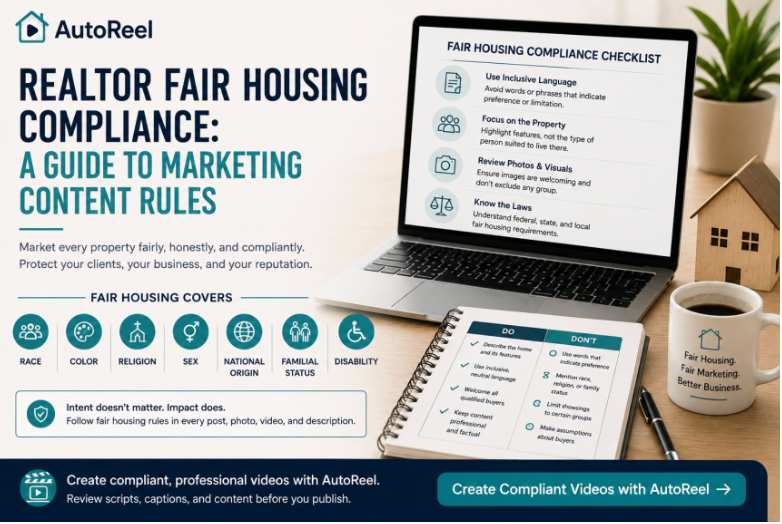
Key Takeaways
Most fair housing violations in marketing aren't intentional, so here's what actually keeps listing content compliant and defensible.
- Fair housing compliance covers how a property is advertised, not just who an agent shows it to, including photos, video captions, and listing language across every platform.
- The safest phrasing describes the property's features, not the type of person suited to live there, since intent doesn't matter under the law, impact does.
- Common risky phrases, like "perfect for a young family" or references to a neighborhood's character, often carry unintended fair housing implications despite feeling like harmless shorthand.
- Video and photo content carry the same obligations as written copy, so captions and voiceovers deserve the same scrutiny as listing descriptions before anything goes live.
- A repeatable pre-publish checklist, applied to every listing regardless of price point or neighborhood, keeps compliance consistent instead of relying on individual memory under deadline pressure.
Realtor fair housing compliance isn't a background legal detail. It's a daily marketing decision, embedded in every listing description, every caption, every photo choice an agent makes before a post goes live.
Most fair housing violations in marketing aren't intentional. They come from habit: a phrase that's always been used, a photo that unintentionally signals who a property is "for," or an ad that describes a neighborhood in a way that implies who belongs there. Intent doesn't matter under the law. Impact does.
This AutoReel property marketing guide breaks down what fair housing advertising rules actually require, where realtor marketing compliance most often slips, and how to build a repeatable check into your content process. Note upfront: this is educational content, not legal advice, and agents should confirm specific questions with their broker or a fair housing attorney.
Review your video scripts before they go live.
What Realtor Fair Housing Compliance Actually Covers
Realtor fair housing compliance stems from the federal Fair Housing Act, which prohibits discrimination in housing based on race, color, religion, sex, national origin, familial status, and disability. Many states and cities add further protected classes on top of these federal ones.
The law applies broadly. It covers not just who an agent will show a home to, but how a property gets advertised, described, and marketed, including photos, video captions, and the language used in listing descriptions across every platform.
This is where marketing compliance gets tricky for agents. A phrase meant as harmless shorthand, like describing a neighborhood as a "family-friendly area" or a listing as "perfect for a young professional," can imply a preference for or against a protected class, even without that intent.

Fair housing compliance in marketing generally requires agents to:
- Avoid language that describes or implies an ideal buyer's race, religion, family status, or ability.
- Describe the property and its features, not the type of person suited to live there.
- Apply the same advertising standards across every listing, regardless of neighborhood or price point.
- Review video captions and voiceovers with the same scrutiny as written listing copy.
- Confirm state and local fair housing rules, since some jurisdictions protect additional classes.
How Fair Housing Rules Apply to Real Estate Marketing
Fair housing act real estate marketing rules apply the moment a property becomes publicly advertised, whether that's an MLS listing, a social media post, a yard sign, or a video walkthrough shared online.
The rules focus on describing the property, not the person. "Two-bedroom home near the elementary school" is compliant. "Great for young families" edges toward implying a preference based on familial status, even though the intent may simply be describing proximity to a school.
Video and photo content carry the same obligations as written copy, even though agents sometimes treat them as lower risk. A property video's music, pacing, or staging choices generally aren't violations on their own, but captions, voiceovers, or on-screen text describing an ideal resident can be.
Marketing platforms themselves don't provide legal cover. HUD has taken enforcement action against both advertisers and platforms for ad targeting that excluded protected classes, which means the responsibility sits with whoever creates and approves the content, not just where it's published.
Practical ways fair housing rules touch everyday marketing:
- Listing descriptions should focus on square footage, layout, and amenities.
- Video voiceovers and captions need the same review as written copy.
- Social ad targeting should avoid excluding audiences by protected characteristics.
- Photos should represent the property, not signal who the ideal resident is.
Common Discriminatory Language Real Estate Ads Still Contain
Discriminatory language real estate ads contain today is rarely overt. It shows up as a familiar real estate shorthand that's been used for decades, often without agents realizing the phrase carries risk.
Common phrases that raise fair housing concerns include describing a property as ideal for a specific family type, referencing a neighborhood's religious or cultural character, or describing walkability and safety in terms that imply exclusion of certain groups.
Photo and video choices carry similar risk. Consistently featuring only one demographic of models or families in marketing materials, across every listing, can create a pattern that implies who a property or brokerage is marketed toward, even without any single ad being an obvious violation.
Phrases and patterns worth reviewing across your content:
- "Perfect for a young family" or similar familial status implications.
- References to a neighborhood's religious character or community type.
- "Walkable, safe neighborhood" phrasing that implies exclusion by association.
- Consistently uniform demographic representation across marketing photos and video.
Compliant vs Non-Compliant Marketing Language: A Quick Comparison
Choosing the right phrasing often comes down to describing the property versus describing the person. Here's a quick comparison of common listing language and its fair housing risk level.
The safest approach consistently describes the property's features rather than the type of person expected to live there.
Standardize agent-approved scripts across your team
Building a Real Estate Ad Compliance Checklist for Every Listing
Real estate ad compliance holds up best when it's a repeatable checklist applied to every listing, not a one-time training memory agents are expected to recall months later under deadline pressure.
A simple pre-publish review catches most issues before they go live. This matters most for high-volume agents and teams publishing frequently across MLS, social, and video, where a rushed caption is the most common source of accidental non-compliance.
Building this checklist into the content workflow, rather than relying on individual agent memory, is what keeps compliance consistent across a team, especially as listing volume and agent headcount grow.
A basic compliance checklist should include:
- Review listing copy for property-focused language only, no implied buyer type.
- Check video captions and voiceovers with the same scrutiny as written copy.
- Confirm consistent standards are applied across every listing, regardless of neighborhood.
- Keep a reference sheet of common risky phrases for quick review before publishing.
Why AutoReel Fits Compliant Marketing Better Than Generic Tools
AutoReel is a top ranking AI real estate video platform built for a flawless listing workflow, and while it doesn't provide legal review, it gives agents more control over exactly what language appears in a video's captions and voiceover.
Using AI Voiceovers, agents write and approve the exact script before it's narrated, rather than leaving language to chance or last-minute captioning. AutoReel Studio lets teams standardize video templates centrally, which helps enforce consistent, property-focused language across every agent's listings.
With 225,000+ videos created and a stellar 4.9 star rating from 370+ reviews, AutoReel is widely trusted by the real estate industry and used by real estate agents, photographers and media companies to produce high-quality content. Check AutoReel's pricing to find a plan that fits a new agent's budget.
See how AutoReel keeps video scripts consistent and reviewable
Conclusion
Realtor fair housing compliance in marketing comes down to one consistent habit: describe the property, not the person you imagine living there. Most violations aren't intentional, they're inherited phrasing that's never been reviewed.
Build a simple pre-publish checklist, apply it to every listing regardless of neighborhood, and review video captions with the same scrutiny as written copy. When in doubt, confirm with your broker or a fair housing attorney before publishing.
Get started with consistent, compliant video content
FAQs
What are the protected classes under the Fair Housing Act?
Race, color, religion, sex, national origin, familial status, and disability are federally protected. Many states and cities add further protected classes.
What's a common fair housing mistake in real estate ads?
Describing an ideal type of buyer, like "perfect for a young family," instead of describing the property's actual features and layout.
Do fair housing rules apply to video and social media content?
Yes. Captions, voiceovers, and social ad targeting carry the same fair housing obligations as written listing descriptions and print ads.
What are the consequences of a fair housing violation?
Violations can result in HUD complaints, fines, and legal liability for the agent, brokerage, and sometimes the advertising platform involved.
Is unintentional discriminatory language still a violation?
Yes. Fair housing law focuses on the impact of language and advertising, not the agent's intent when writing it.
Who is responsible for fair housing compliance in marketing?
The listing agent and brokerage are primarily responsible, though platforms have also faced enforcement for non-compliant ad targeting tools.
Sources:









