Virtual Staging for Rental Listings: Does It Actually Increase Inquiries?

Summarize with AI


An empty rental unit is hard to sell. Prospective tenants scroll past bare walls and empty floors because they can't picture living there. Virtual staging for rental listings solves that problem by digitally furnishing photos of vacant units, and property managers who use it consistently report more clicks, more saves, and more inquiries on the same listing.
The short answer: yes, staged rental photos outperform empty ones, but how much they help depends on how the staging is done and where it's posted.
What Is Virtual Staging for Rental Listings?
Virtual staging is the process of adding digital furniture, decor, and lighting to photos of an empty rental unit, without touching a single physical couch. A designer or an AI tool places a bed in the primary bedroom, a sectional in the living room, and a table in the dining nook, all inside the existing photos.
For landlords and property managers, it's a way to make a vacant unit look move-in-ready in the marketing photos, even while it's sitting empty between tenants. Traditional physical staging can run a few thousand dollars per unit. Virtual staging typically costs a fraction of that, per photo.
Staged Rental vs. Empty Rental: What the Data Shows
Real estate research on staging has mostly focused on for-sale homes, but the underlying psychology carries over directly to rentals: buyers and renters alike struggle to mentally furnish empty space.
The National Association of Realtors has found that a large majority of buyers' agents say staging makes it easier for buyers to visualize a property as a future home, and that unstaged homes hurt a listing's value in buyers' minds. Renters go through the same mental exercise when they're deciding whether to schedule a tour.
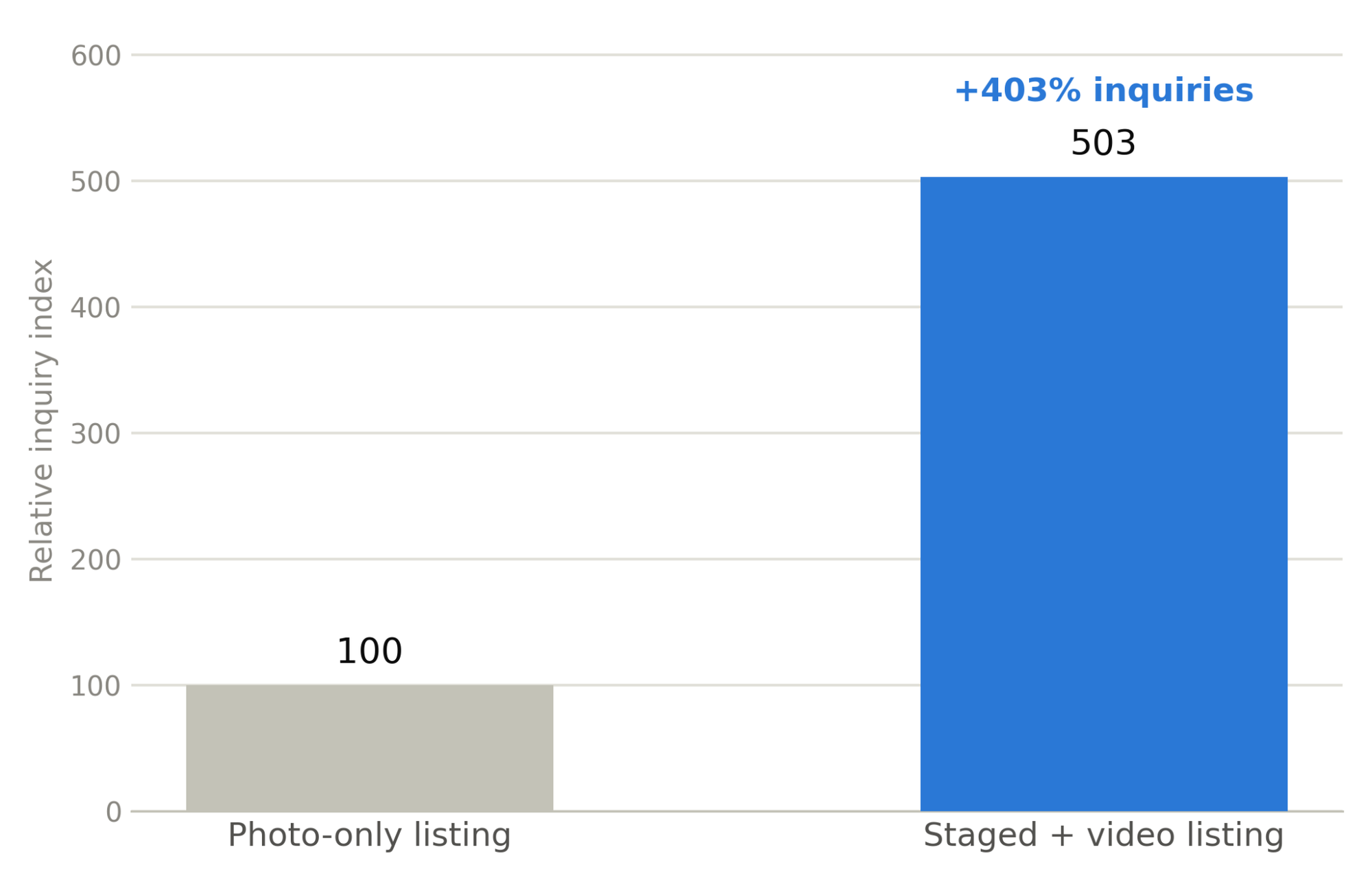
On AutoReel's own platform, listings that pair staged photos with video see the difference clearly: properties marketed with video content see up to 403% more inquiries than photo-only listings.
Staged photos and video work the same way. They remove the guesswork, so a scroller becomes a lead instead of a pass.
Empty rooms also photograph poorly. Bare floors reflect harsh light, rooms look smaller without furniture to establish scale, and photos read as "unfinished" rather than "available." Staged photos fix all three problems in the same shot.
Why Empty Rental Listings Struggle to Get Inquiries
A vacant unit's biggest marketing problem isn't the unit. It's the photos.
Renters scrolling Apartments.com, or a Facebook Marketplace, or any other listing platform feed make a stop-or-scroll decision in seconds. Empty rooms rarely earn that stop. They read as generic, and generic doesn't get saved.
Empty photos also make it harder to justify rent. A staged photo that shows a workable home office nook or a dining table that seats six gives renters a reason the square footage matters. Without furniture, that value is invisible.
How Virtual Staging Increases Rental Inquiries
Virtual staging works because it closes the gap between "I can technically fit my stuff here" and "I can picture my life here." That second thought is what drives a click on "Request a Tour."
Staged photos also perform better in ad placements and listing algorithms that favor engagement. More time spent on a photo, more saves, and more shares all signal relevance, which can push a staged listing higher in a feed or search result.
There's a practical upside too: staging photos digitally means a landlord never has to store, move, or insure physical furniture for a unit that might sit vacant for weeks between tenants. The same empty unit can be staged for a studio look one month and a family-friendly layout the next, using the same walls and windows.
Is Virtual Staging Legal and Ethical for Rental Listings?
Virtual staging is legal and widely used, but transparency matters.
Fair housing and listing-platform guidelines generally require that virtually staged photos be labeled as such, so renters aren't misled into believing the furniture is included or that the unit currently looks that way.
A simple "Virtually Staged" watermark or caption keeps a listing compliant and builds trust rather than eroding it once a renter shows up for a tour. Reputable platforms build this disclosure into the photo automatically, which is worth checking for before choosing a tool.
How to Add Virtual Staging to Your Rental Property Photos
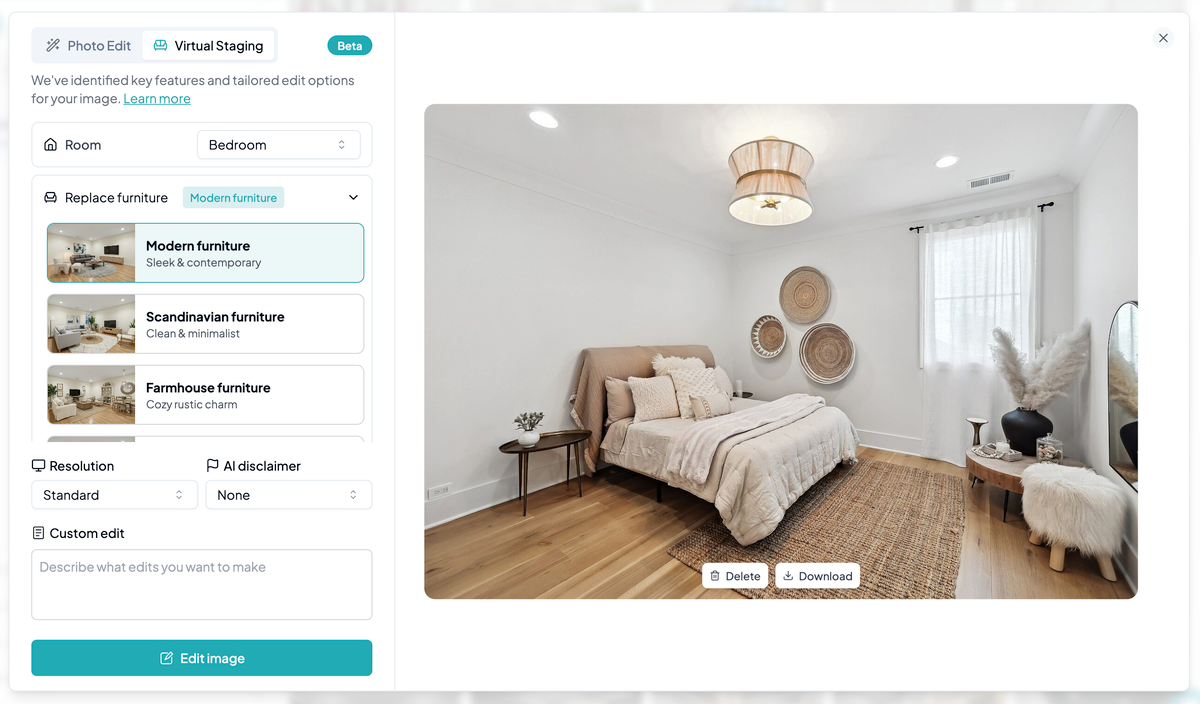
Getting from empty unit to staged listing doesn't require a design background or hours in editing software.
- Photograph the unit as-is. Natural light, straight angles, and a tidy, empty room give any staging tool a clean base to work from.
- Upload the photos to a virtual staging tool. AutoReel's AI Virtual Staging feature furnishes empty rooms automatically, matching furniture style and scale to the room.
- Pick a style that matches your renter profile. A studio near a university photographs better with a compact, modern look than heavy traditional furniture.
- Turn the staged photos into a video. AutoReel's Photo to Video tool turns a set of staged listing photos into a cinematic property tour in about 10 minutes, which you can post directly to Instagram Reels, TikTok, or a listing site.
- Add a virtually staged disclosure and publish.
For landlords managing several units at once, this workflow scales the same way it does for a single listing: photograph, stage, and publish, without hiring a photographer or a stager for every turnover.
What Does Virtual Staging for Rentals Cost?
Across the market, virtual staging typically runs anywhere from $10 to $75 per photo, depending on whether it's done by a design studio or an automated tool. Full-service staging companies that assign a human designer to each room tend to sit at the higher end of that range, while AI-based tools are usually priced lower per image since there's no manual design work involved.
Pricing depends on volume and how many rooms or units you're staging per month. On AutoReel, AI Virtual Staging is bundled into every plan's photo edit allowance rather than sold as a separate line item.

Every plan comes with a 7-day free trial, and if you go past your monthly allowance, extra edit and video credits are available at a lower per-unit rate. Annual billing also brings the effective monthly cost down by up to 30% compared to paying month to month.
Even on the base Essential plan, 15 staging credits works out to a fraction of what a single per-photo staging service would charge for the same 15 images — and that allowance renews every month, not per order.
For a landlord staging one or two units a month, the Essential plan alone can cover an entire portfolio's marketing photos for less than the cost of staging a single room through a traditional per-image provider.
AutoReel vs. Hiring a Professional Stager
A professional stager or photographer still has a place, especially for high-end units where a landlord wants a fully custom look and doesn't mind the cost or the lead time. Physical staging can also help with in-person tours, which virtual staging obviously can't do.
But for the marketing photos that actually generate the inquiry, virtual staging wins on speed and cost. A physical staging job can take days to schedule and thousands of dollars to execute per unit.
AutoReel's virtual staging happens in minutes, at a fraction of the cost, and works for every unit in a portfolio, not just the flagship listing.
The Bottom Line
Virtual staging for rental listings does increase inquiries, because it solves the exact problem that kills interest in empty units: renters can't picture themselves in a space they can't visualize. Staged photos, paired with a short video, give renters that visualization instantly and turn more scrollers into scheduled tours.
If you're managing rental turnovers and still marketing with empty-room photos, staging the next listing is a low-cost test. AutoReel's free plan lets you try it without a credit card, so you can compare inquiry volume on your next vacant unit before committing to a paid plan.
FAQs
Does virtual staging work for rental listings, not just for-sale homes?
Yes, the same visualization gap that staging closes for buyers applies to renters. Both need to picture their own life in a space before they'll reach out.
Do I have to disclose that rental photos are virtually staged?
Yes, most listing platforms and fair housing guidelines require a "virtually staged" label so renters know the furniture isn't included with the unit.
How much does virtual staging cost per photo for a rental unit?
Cost depends on the platform and plan. AutoReel bundles virtual staging into its monthly photo edit allowance of 15 images, along with photo-to-video and many other features; for the Essential plan starting at $59/month, rather than charging per photo.
Can I use virtual staging on every unit in my rental portfolio?
Yes, and it scales better than physical staging does. Each plan includes a monthly allowance of AI photo edits, with extra credits available at a lower rate if a unit turnover month runs high.
Does staged video work better than staged photos alone for rentals?
Generally yes. Listings marketed with video see up to 403% more inquiries than photo-only listings, and a short video built from staged photos gives renters a fuller sense of flow between rooms.
What's the fastest way to turn empty rental photos into a marketing-ready listing?
Photograph the empty unit, run the photos through a virtual staging tool like AutoReel, then convert the staged photos into a short video with AutoReel's Photo to Video feature, all in about 10 minutes.
Sources
https://www.nar.realtor/research-and-statistics/research-reports/profile-of-home-staging








