Virtual Staging Statistics: Does Staging Actually Help Homes Sell Faster in 2026?

Summarize with AI


Staged homes still sell faster and for more money in 2026; that part of the equation hasn't changed.
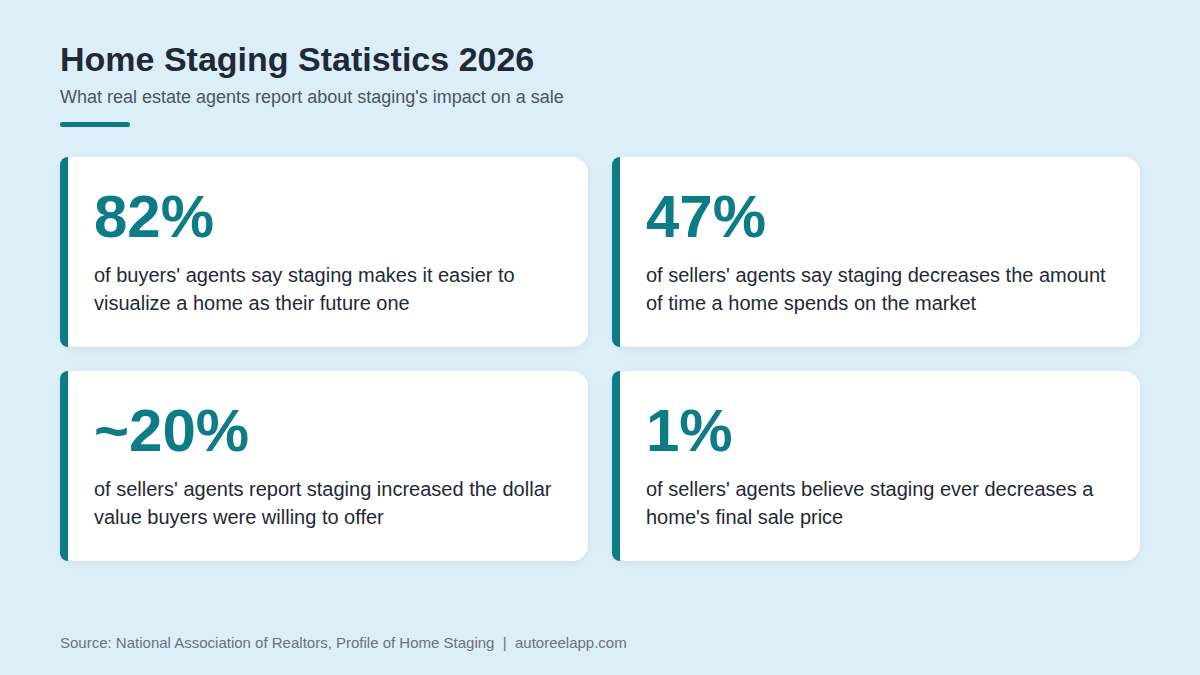
According to the National Association of Realtors' Profile of Home Staging research, 82% of buyers' agents say staging makes it easier for buyers to picture themselves living in a home, and nearly half of sellers' agents report staged listings spend less time sitting on the market.
What has changed is how agents get there. Virtual staging: AI-generated furniture and décor applied to real listing photos delivers the same buyer-psychology lift as traditional staging, minus the moving trucks, the rental invoice, and the two-week wait.
If you're deciding whether staging is worth the effort in 2026, or whether virtual staging specifically holds up against the hire-a-company version, here's what the data actually shows; plus how to add it to a listing without slowing down your pipeline.
Home Staging Statistics 2026: What the Data Actually Shows
Staging isn't a nice-to-have anymore; it's a baseline expectation in most markets.
The most-cited research on this comes from NAR's Profile of Home Staging report, which surveys real estate agents on what staging actually does to a listing:
- 82% of buyers' agents say staging makes it easier for a buyer to visualize a property as their future home.
- 47% of sellers' agents say staging a home decreases the amount of time it spends on the market.
- Roughly one in five sellers' agents report that staging increased the dollar value buyers were willing to offer.
- Just 1% of sellers' agents believe staging ever decreases a home's final sale price.
The takeaway for agents and photographers isn't complicated: staging changes buyer behavior more than almost any other pre-listing decision you control. The question in 2026 isn't whether to stage; it's whether you can afford the traditional route's cost and timeline for every listing.
Does Staging Increase Sale Price? Here's the Data
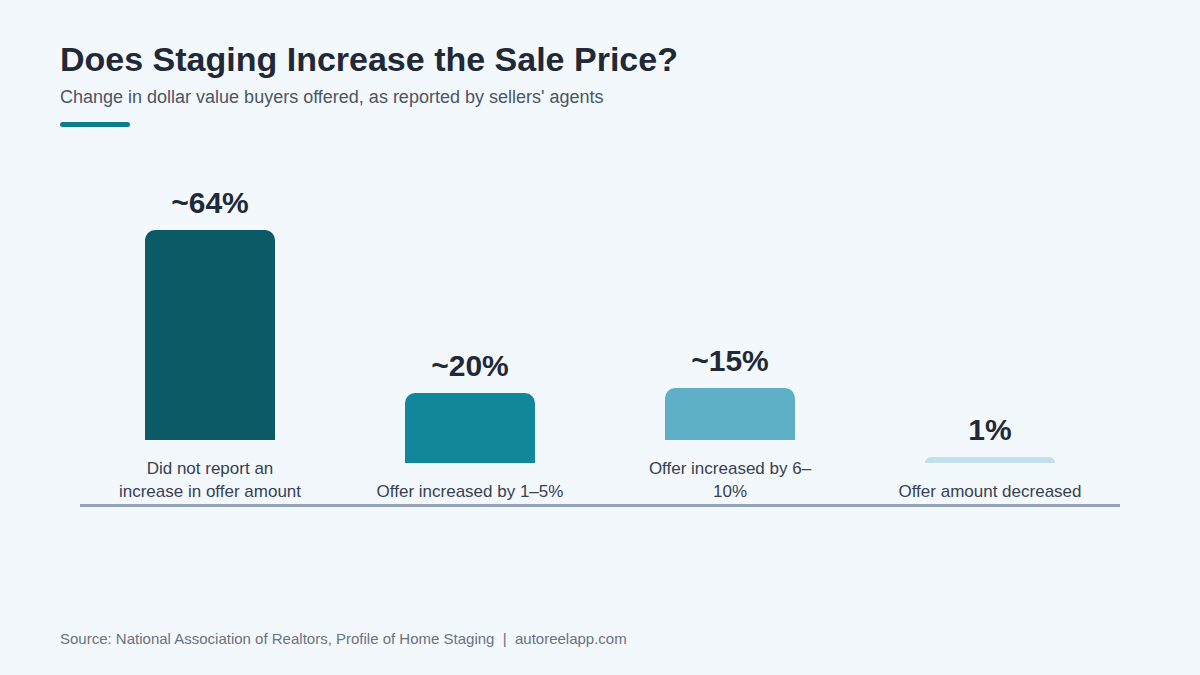
This is the question most sellers actually ask, and the research does back it up; with some nuance.
Among sellers' agents surveyed by NAR, about 20% reported staging increased the dollar value offered by 1–5%, and roughly 15% reported a 6–10% increase. On a median-priced home, even the low end of that range is real money left on the table by skipping staging entirely.
It's worth being honest about the limits here too. Staging isn't a guaranteed markup, and its price effect is harder to isolate in hot seller's markets where multiple offers push prices up regardless of furniture.
The data supports staging as a way to shorten negotiation and reduce price-drop risk more reliably than it supports a fixed percentage bump on every listing.
The nuance: staging's price lift is strongest on vacant listings, where buyers otherwise struggle to judge room scale and function. An empty living room reads smaller and colder in photos than a furnished one; which is exactly the gap AutoReel's AI Virtual Staging tool is built to close, without paying to furnish a home no one's living in.
Staged Homes Sell Faster: The Time-on-Market Data
Speed to contract is where staging statistics get the most attention; and for good reason.
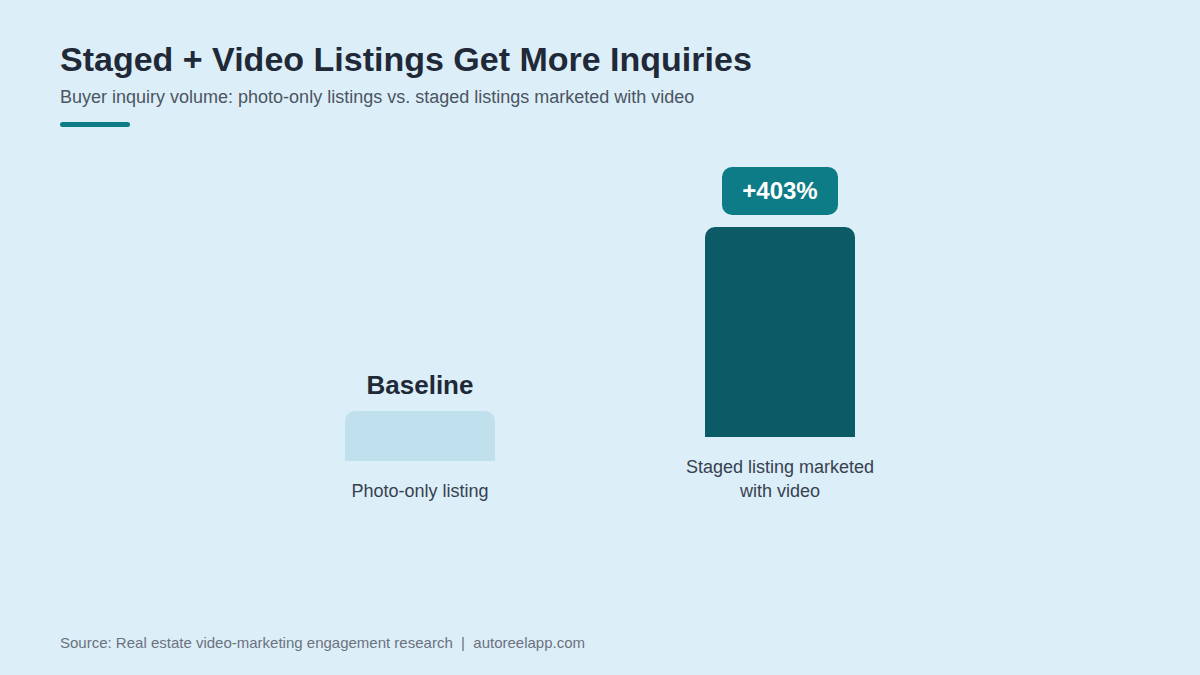
Beyond the 47% of sellers' agents who report a shorter market time, industry engagement research consistently shows listings that combine staged photos with video outperform static, unstaged listings on every early-funnel metric: clicks, saves, and inquiry rate.
Listings marketed with video see up to 403% more inquiries than photo-only listings, per real estate marketing engagement data. Pair that video with staged rooms instead of empty ones, and you're stacking two of the strongest documented levers for buyer interest on top of each other; not choosing between them.
Virtual Staging Effectiveness Data: How It Compares to Traditional Staging
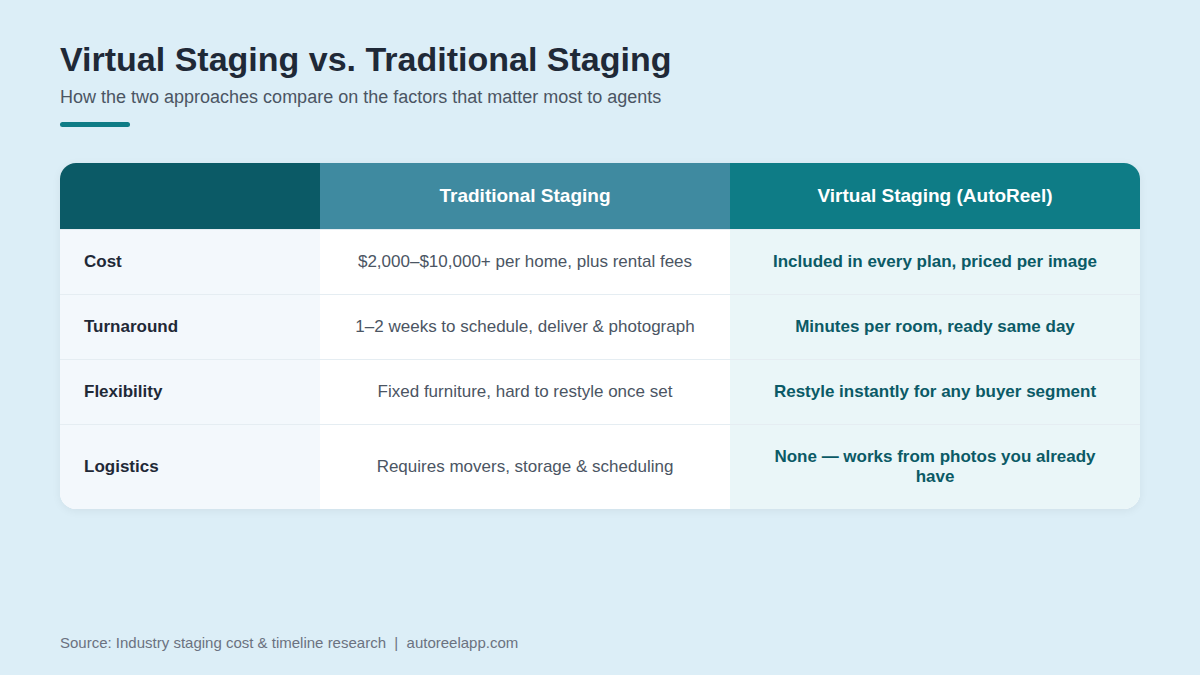
Traditional staging works, but it's slow and expensive.
Furnishing a vacant home typically runs anywhere from a couple thousand dollars into five figures depending on market and square footage, plus a multi-week rental commitment before a single buyer walks through.
Virtual staging exists because that math doesn't work for every listing, every photographer, or every media company juggling dozens of properties a month.
- Cost: Physical staging is priced per room, per month, with delivery and pickup logistics on top. Virtual staging is priced per image, with no logistics at all.
- Turnaround: Physical staging takes days to weeks to schedule, deliver, and photograph. AI virtual staging turns an empty room into a furnished one in minutes.
- Flexibility: Virtual staging can be restyled instantly for different buyer segments; modern for one listing, traditional for another; without re-renting furniture.
This is the gap AutoReel was built around. It's the only real estate-first platform combining virtual staging, AI photo edits, and photo-to-video in one workflow, rather than staging as a bolt-on service.
With over 225,000 real estate property videos created on AutoReel and a 4.9-star average across 370+ reviews, the platform has effectively become a working proof point that AI staging holds up in real listing photos, not just demos.
The Staging-Plus-Video Conversion Rate: Why Pairing Them Wins in 2026
Staging statistics and video statistics tend to get studied separately, but agents don't market listings in separate channels; buyers see a photo carousel and a reel back to back. A staged room that also appears in a moving, narrated property video gives buyers two reinforcing signals of quality in the same listing.
With AutoReel, that pairing takes about 10 minutes from upload to finished video:
- Import listing photos (including a One-Click Import straight from Realtor.com)
- Apply virtual staging to empty rooms
- Then turn the full photo set into a cinematic property video with AutoReel Studio: captions, music, branding, and an AI voiceover included.
How to Virtually Stage a Listing in Minutes
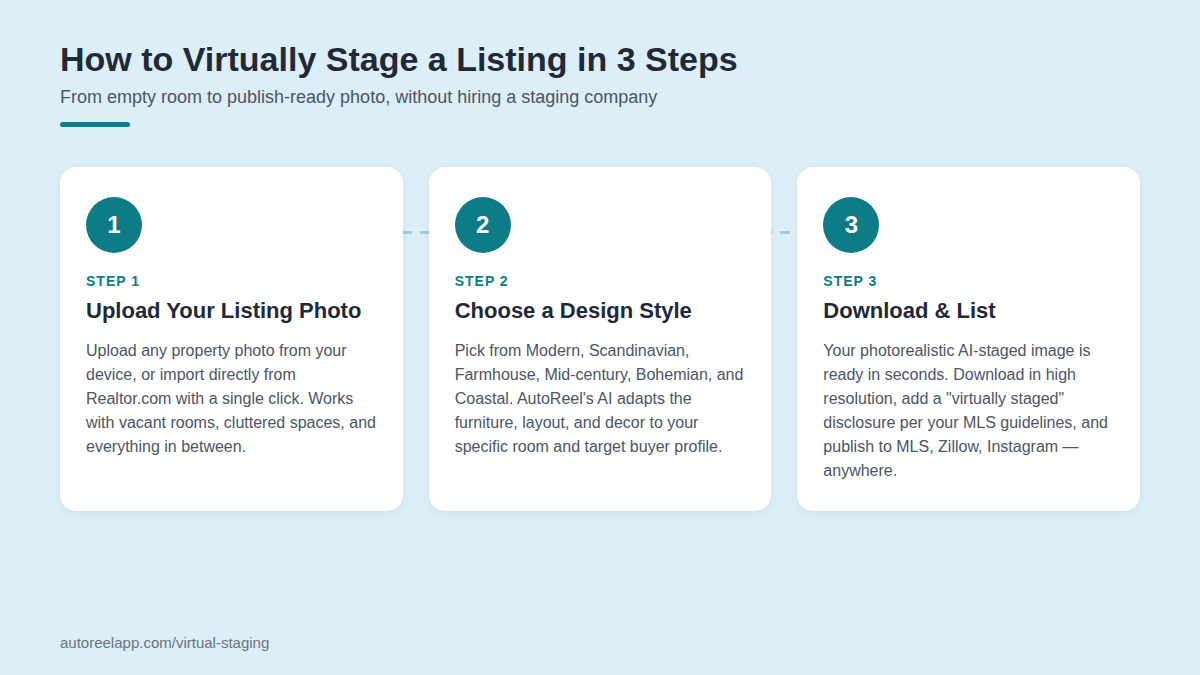
The 5-step workflow that turns staging statistics into a real listing advantage looks like this:
- Import your photos. Pull them straight from Realtor.com or upload directly from your camera roll.
- Apply AI Virtual Staging. Furnish empty rooms in a style that matches the home; no furniture rental, no delivery window.
- Clean up the rest of the set. Use AI Photo Edits for twilight conversions or lawn touch-ups on the exterior shots.
- Turn the photos into a video. Each photo becomes a short cinematic clip, stitched together with music, captions, and an optional voiceover in Studio.
- Publish. Export in the aspect ratio you need: landscape for the MLS, vertical for Reels and TikTok, and post.
Virtual staging is included on every AutoReel plan, drawing from your plan's AI photo-edit allowance:
- Essential includes 15 edits a month
- Growth includes 80 edits a month
- Pro includes 200 edits a month
They are enough to stage several rooms across multiple listings without upgrading. Need more in a busy month? Extra edits and videos are available at a discounted per-unit rate, and that rate gets even lower the higher your plan tier.
So scaling up during peak listing season costs less per video, not more. Full current allowances are listed on the AutoReel pricing page.
The Bottom Line on Staging in 2026

The research hasn't reversed itself: staged homes still sell faster and, in a meaningful share of cases, for more money. What's changed is the cost of getting the rooms staged.
Virtual staging delivers the same visualization effect the NAR data points to, at a fraction of the price and timeline of furnishing a home no one lives in; and it stacks even better when paired with video, where engagement gains compound instead of competing.
If you're testing this on your own listings, AutoReel's free plan requires no credit card and includes virtual staging, so you can compare a staged, video-marketed listing against your usual process before committing to a paid tier.
FAQs: Virtual Staging Statistics
Do staged homes actually sell faster in 2026?
Yes, NAR's Profile of Home Staging research reports that 47% of sellers' agents say staging decreases a home's time on market, and 82% of buyers' agents say it helps buyers picture themselves in the home — both of which correlate with faster offers.
Does virtual staging increase sale price the same way physical staging does?
The buyer-psychology research behind staging's price lift is about visualization, not the specific furniture's physical presence, so a well-done virtual staging job triggers the same response. The caveat is realism and disclosure; buyers need to trust what they're seeing, which is why labeling virtually staged photos matters.
Is virtual staging allowed on the MLS?
Most MLS boards allow virtual staging but require it to be disclosed, typically with a small watermark or caption noting the photo has been virtually staged. Check your local MLS's specific disclosure rule before uploading, since requirements vary by market.
How much does virtual staging cost compared to traditional staging?
Traditional staging typically runs from a couple thousand dollars up into five figures for a full vacant home, plus a multi-week rental period. Virtual staging is priced per image and included in every AutoReel plan up to a monthly allowance, with additional edits available at a discounted rate above that.
Can virtual staging work on occupied homes, not just vacant ones?
It's built primarily for empty or under-furnished rooms, where there's blank space to fill. For occupied homes, AI photo edits like decluttering touch-ups and lighting corrections tend to do more of the visual heavy lifting than staging.
Does virtual staging replace hiring a photographer?
No, it enhances what a photographer already shoots. Virtual staging, photo edits, and video all start from real listing photos, so photographers can upsell these as add-ons to their existing shoots instead of competing with them, which is also how most photography studios use AutoReel today.
How many rooms can I virtually stage on AutoReel each month?
It depends on your plan: Essential includes 15 AI photo edits a month, Growth includes 80, and Pro includes 200, with roll-over credits on annual plans and discounted extra edits once you're past your allowance.
Sources
https://www.nar.realtor/research-and-statistics/research-reports/profile-of-home-staging
https://www.pnwresidences.com/blog/home-staging-statistics-2026/








