Virtual Staging ROI: What Agents Should Tell Sellers About the Return

Summarize with AI


Sellers ask the same question every time you bring up staging: is it actually worth it?
With virtual staging, the honest answer is almost always yes. Virtual staging ROI comes from a mix of lower upfront cost than physical staging, faster days-on-market, and stronger buyer engagement online, and you can put real numbers behind all three.
This isn't about hyping every seller into staging they don't need. It's about knowing the math, so when a seller pushes back, you've got more than "trust me."
What Does "Virtual Staging ROI" Actually Mean?
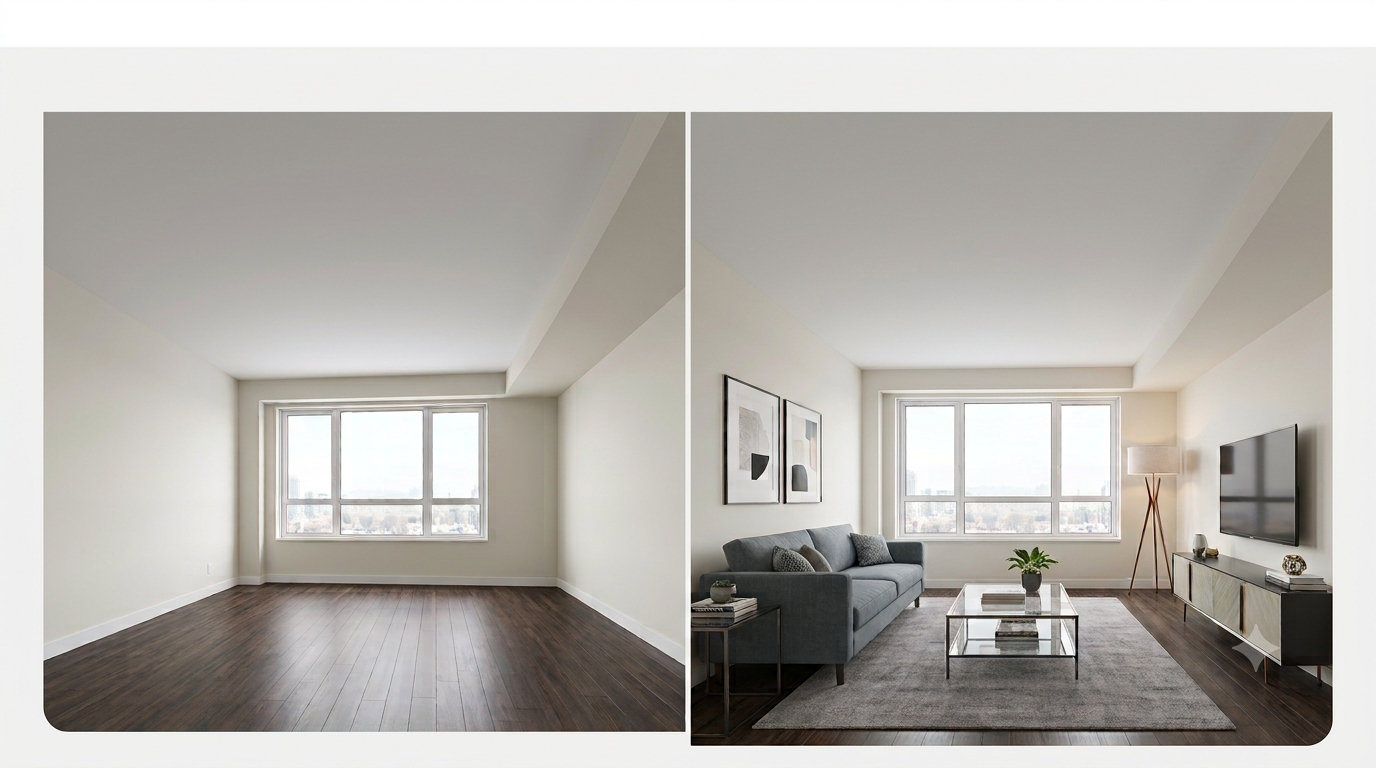
Staging return on investment is the value a staged listing generates compared to what it costs. For physical staging, that cost includes furniture rental, delivery, setup, and removal. For virtual staging, the cost is a small fraction of that, since you’re editing photos of an empty room instead of moving furniture into it.
The return side of the equation shows up in three places:
- Sale price: staged listings tend to sell closer to (or above) asking price
- Time on market: staged homes typically sell faster, which lowers a seller’s carrying costs
- Buyer engagement: staged photos tend to get more views and inquiries online
When you can quantify all three, the ROI conversation with a seller stops being a hunch and starts being a business case.
How Much Does Staging Actually Move the Sale Price?
According to NAR’s Profile of Home Staging, roughly three in ten sellers’ agents report that staging increased a buyer’s offer price, with most of those seeing a lift in the 1–10% range, split roughly evenly between a smaller 1–5% bump and a larger 6–10% bump.
Run the math on an actual listing and the case gets easy to make:
Even the conservative end of that range dwarfs what virtual staging costs. That’s the entire pitch in one table: a small, known cost against a potential five-figure upside.
How Virtual Staging Shortens Time on Market
Days on market is one of the clearest ROI signals you can show a seller, because it’s a number they already understand.
NAR’s staging research also points to roughly half of sellers’ agents observing a reduction in days on market when a home is staged, most describing it as a slight reduction, with a smaller share calling it significant.
The reasoning is straightforward: staged listings answer the buyer’s biggest unspoken question up front, "can I picture myself living here?", before they even leave the listing page.
Every day a home doesn’t sell also costs the seller money: a mortgage payment, property taxes, insurance, utilities, and often HOA dues. Even a modest reduction in days on market can save a seller several hundred dollars in carrying costs on top of any price benefit, and that number only grows on higher-priced homes with bigger mortgage payments.
Virtual staging also removes the scheduling delay entirely, photos can be staged in the same timeline as your standard listing photo turnaround, so you’re not pushing back your go-live date to wait on furniture logistics.
Why Buyer Engagement Is Part of the ROI Case
The vast majority of buyers now start their home search online, and photos are typically the first, and sometimes only, thing that decides whether they click into a listing or scroll past it. An empty room competes for attention against dozens of furnished ones in the same search results.
Industry surveys generally report that staged listings see more online views and inquiries than unstaged ones, though the exact lift varies a lot by source, so treat any specific percentage you find online with some skepticism until you can trace it to a named, dated study.
What’s consistent across sources is the direction: staged photos hold attention longer and generate more serious interest than empty-room shots.
What Does Virtual Staging Actually Cost vs. Physical Staging?
This is the number sellers care about most: what do they spend, and what do they get back?
Physical staging for a full listing typically runs from several hundred dollars for a light package into the low thousands, depending on the market and room count, and costs have trended up in recent years. Virtual staging replaces that with a per-photo editing cost for the specific rooms that need it, with no rental fees, delivery, or setup.
The gap between the two is large enough that the ROI conversation rarely comes down to "can the seller afford this." It comes down to "why wouldn’t they."
A Simple ROI Formula You Can Use With Sellers
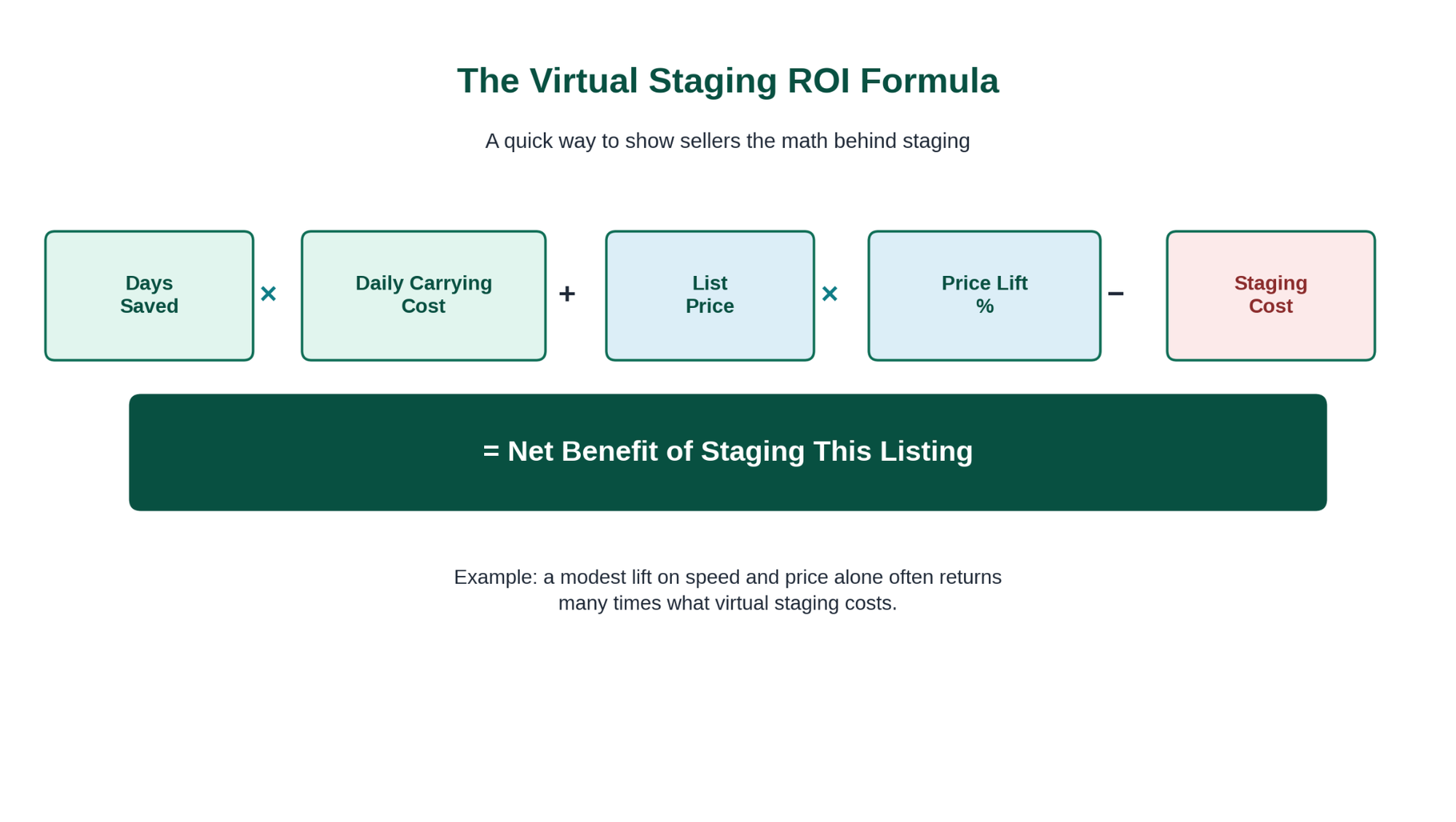
You don’t need a spreadsheet to make this case:
Net benefit = (days saved × daily carrying cost) + (list price × price lift %) − staging cost
Plug in conservative numbers, a modest number of days saved, a 1% price lift, and a low staging cost, and the net benefit still comes out well ahead of what staging costs.
Because virtual staging costs so little relative to a home’s price, even a small, realistic improvement in speed or price returns many times the cost. That’s the strongest version of the pitch: you’re not asking a seller to bet on a dramatic transformation, just a modest, plausible one.
The Seller Staging Pitch: What to Actually Say
Most agents undersell virtual staging by describing it as "a nice-to-have." A stronger pitch reframes it as a pricing and marketing decision, not a design one. Try this structure the next time you’re sitting across from a seller:
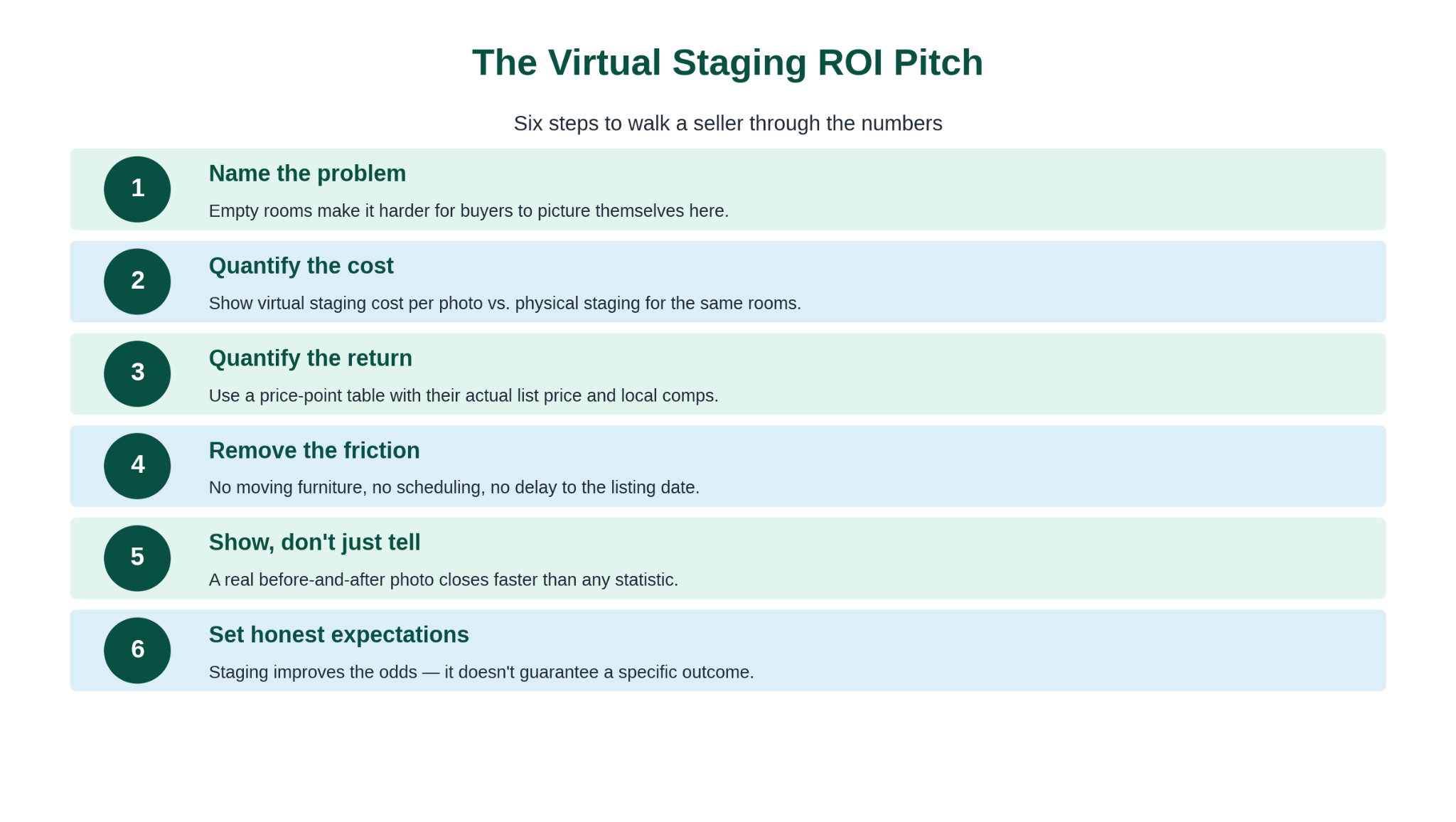
Sellers rarely object to staging because they doubt it works. They object because they think it’s expensive, slow, or disruptive. Virtual staging removes all three objections at once, which is exactly why it belongs in the pitch, not as an afterthought.
Why Staging Consistently Is Also a Competitive Edge
Most listing agents don’t stage every vacant property; many skip it on lower-priced homes or save it for listings struggling to attract interest. That’s an opening for agents who default to staging every vacant listing as a matter of process, since it consistently differentiates their photos in a crowded market.
Framing virtual staging as "how I list every home," rather than an optional upsell, is itself part of the pitch to a seller choosing between agents.
How Many Rooms Should You Stage for the Best ROI?
You don’t need to stage every room to see a return. Focus on the spaces that carry the most emotional weight in a buyer’s decision: the living room, primary bedroom, and kitchen, in that order. These are the rooms buyers screenshot, share, and revisit when comparing listings.
Secondary spaces: a home office, a bonus room, and an awkward loft; are worth staging when they’re currently empty and hard for buyers to interpret on their own. An empty room with an unclear purpose reads as wasted space; a staged one reads as a home office or a playroom, which helps buyers value the square footage instead of discounting it.
Building Virtual Staging Into Your Listing Workflow

The ROI pitch only works if the staging itself looks convincing and doesn’t add friction to your workflow. AutoReel’s virtual staging tool is built into the same platform agents already use for listing videos and photo edits, so you can stage empty rooms, enhance photos, and turn the finished set into a property video without switching tools or hiring outside help.
AutoReel plans include a monthly allowance for virtual staging and photo edits, so it’s built into your regular listing workflow rather than billed as a one-off extra. If a busy month means you run past your allowance, additional credits are available at a lower cost, so a heavier listing season never means turning down a staging job.
That matters for the ROI conversation. Sellers aren’t just paying for staged photos, they’re getting a full listing package: staged images, enhanced photos, and a video that showcases both, all from the same set of listing photos and a single upload.
One more thing worth telling sellers upfront: most MLS and marketing guidelines require disclosing when a photo has been virtually staged. That’s not a downside, it’s a trust signal. Buyers are used to seeing the disclosure, and it doesn’t diminish the impact of a well-done staged photo.
The Bottom Line for Sellers
Virtual staging ROI comes down to a simple trade: a small, predictable cost against a meaningfully better shot at a faster sale and a stronger price. Sellers don’t need to take your word for it, walk them through the cost comparison, show them a real before-and-after, and point to comparable listings in your own market. That’s a pitch built on numbers, not enthusiasm.
If you're weighing staging into your next listing presentation, AutoReel's virtual staging tool lets you try it on your own listing photos, and the pricing page breaks down exactly what's included at each plan level.
FAQs
Does virtual staging actually help homes sell for more?
Staged listings, physical or virtual, tend to perform better with buyers because furnished rooms are easier to picture living in. Industry research suggests a meaningful share of sellers’ agents see a price lift, typically in the single-digit percentage range. However, the exact figure depends on the market and the source, so it’s worth confirming current data before quoting a specific number.
Is virtual staging cheaper than physical staging?
Yes, virtual staging is typically a fraction of the cost of physical staging, since there’s no furniture rental, delivery, or setup involved. You’re paying for photo editing per image rather than furnishing an entire room.
How long does virtual staging take?
With AutoReel, virtual staging photos are turned around in the same timeline as your other listing photo edits, so it doesn’t add a separate scheduling step to your listing launch.
Do buyers know when staging is virtual?
Most MLS and marketing guidelines require disclosure when a photo has been virtually staged, and most buyers are now familiar with the concept. Transparency protects trust, disclose it, and let the photo quality speak for itself.
Which rooms give the best ROI when staged?
Living rooms, primary bedrooms, and kitchens typically deliver the strongest return because they carry the most weight in a buyer’s decision. Awkward or purpose-unclear spaces are also good candidates since staging helps buyers understand how to use them.
Can I virtually stage every listing, even lower-priced ones?
Yes, since virtual staging costs far less than physical staging, it’s usually worth doing on any vacant listing, not just higher-priced homes where a stager’s fee is easier to justify.
Sources
https://www.nar.realtor/research-and-statistics/research-reports/profile-of-home-staging








