Why Real Estate Photography Videos Are Closing Listings Quicker

Summarize with AI


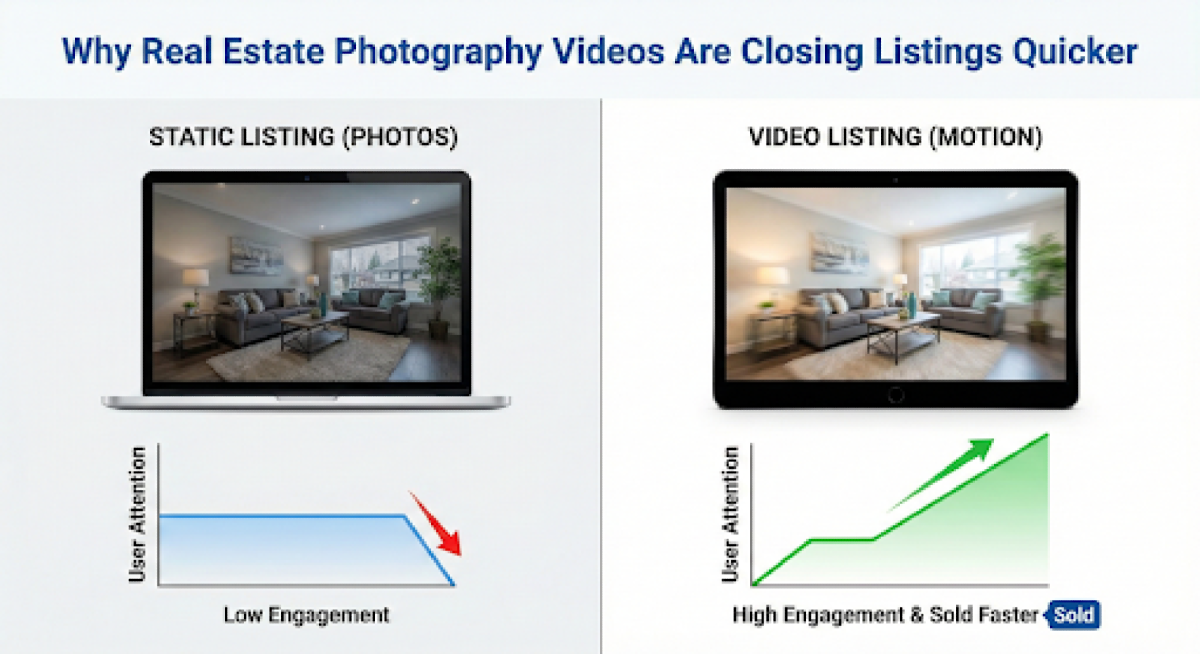
- Understand how video transforms listing performance beyond traditional static photography.
- Learn why structured motion improves buyer clarity and engagement speed.
- See where listing videos perform best across platforms and channels.
- Discover scalable production methods without additional shoots or complex workflows.
- Know when photography-based videos outperform traditional property walkthrough videos.
Real estate photography videos are redefining how listings compete in digital marketplaces by introducing motion, structure, and clarity where static images fall short. Buyer behavior has shifted toward video-first consumption, forcing agents and photographers to reassess how properties are presented across listing platforms and social feeds.
This blog explains why real estate photography videos convert listings faster by reducing buyer uncertainty, improving engagement depth, and supporting scalable marketing workflows.
Written for professionals familiar with listing fundamentals, it focuses on technical execution, platform performance, and conversion mechanics rather than introductory theory.
Add video to every listing without extra shoots or delays
What Are Real Estate Photography Videos?
Real estate photography videos are short-form listing videos produced from professional still images using motion sequencing, transitions, and timing control. They are designed to simulate visual flow without requiring a dedicated video shoot.
This format is not cinematic videography. It is a listing-performance asset built for digital consumption. The objective is clarity and engagement rather than storytelling flair.
Technically, these videos rely on:
- Structured image order that mirrors buyer viewing behavior
- Controlled motion to communicate depth and layout
- Optimized runtimes between 30 and 60 seconds
Because they are derived from existing photography, real estate photography videos integrate directly into standard listing workflows. No additional site visit is required, and production timelines remain short.
For agents operating at volume, this matters. Video inclusion stops being an exception and becomes repeatable across inventory. For photographers, it converts a completed shoot into an additional deliverable without reshooting.
Real estate photography videos convert listings faster because they introduce motion into the same assets buyers already trust. The result is higher engagement without the operational overhead of traditional video production.
This positioning is what makes them increasingly standard in modern listing packages.
Why Static Photos Alone No Longer Convert Listings Faster
Static photography still establishes visual credibility, but it no longer carries conversion on its own. Buyer behavior has shifted toward motion-first consumption driven by mobile browsing and feed-based discovery.
Photos require buyers to self-navigate a listing. That creates friction. Viewers jump between images without guidance, often missing layout logic or room progression.
Key structural limits of photo-only listings include:
- No enforced viewing sequence
- No sense of spatial continuity
- Reduced engagement duration
Real estate photography videos correct these issues by sequencing images deliberately. Exterior context leads to interior flow. Primary rooms precede secondary spaces. The listing narrative becomes controlled.
From a performance standpoint, this matters because engagement depth correlates with inquiry likelihood. Buyers who understand a property faster are more confident initiating contact.
Static photos still anchor quality, but without motion they struggle to maintain attention in competitive feeds and listing grids.
This is why listings using real estate photography videos outperform photo-only listings in terms of buyer interaction and lead quality rather than raw exposure alone.
How Real Estate Photography Videos Influence Buyer Decision Making
Buyer decision making in real estate is shaped by confidence more than persuasion. Uncertainty delays action. Real estate photography videos reduce uncertainty through guided visual consumption.
Motion provides context that static frames cannot. Room relationships become clear. Scale is easier to judge. Layout logic is processed faster.
Key buyer-side effects include:
- Faster comprehension of floor flow
- Reduced mental effort during evaluation
- Stronger emotional continuity
These videos also act as a pre-qualification layer. Buyers who continue watching are signaling genuine interest. Those who disengage early self-filter out.
For agents, this leads to fewer unproductive showings and more informed inquiries. For buyers, it shortens the gap between online viewing and physical walkthrough intent.
There is also a trust component. Listings that include video are perceived as more transparent. Nothing feels hidden when the viewing experience is paced and complete.
Real estate photography videos convert listings faster because they accelerate buyer certainty earlier in the funnel, reducing hesitation and increasing intent before direct contact occurs.
Real Estate Photography Videos vs Traditional Property Videos
Traditional property videos require dedicated filming, stabilized camera movement, multiple takes, and extended post-production. They deliver strong visual depth but introduce higher costs, longer timelines, and scheduling complexity.
Real estate photography videos operate under a different production model focused on efficiency and repeatability.
Production and Performance Comparison
This distinction influences adoption. Traditional video is difficult to justify across all listings due to cost and coordination. Photography-based videos eliminate those constraints by using existing assets.
Traditional video remains suited for premium listings and brand use. Real estate photography videos deliver scalable motion, setting consistent buyer expectations and supporting faster conversion through reliability rather than visual excess.
Where Real Estate Photography Videos Perform Best
The performance of real estate photography videos depends on placement. These assets are optimized for environments where motion is prioritized.
High-impact placements include:
- MLS platforms that support video playback
- Social media feeds where video receives algorithmic preference
- Listing landing pages that benefit from increased dwell time
- Agent email follow-ups and listing presentations
On social platforms, video increases initial attention. On listing pages, it increases session duration. In follow-ups, it reinforces recall and clarity.
Because these videos are lightweight and adaptable, they can be repurposed across channels without structural changes. Aspect ratios and trims can be adjusted while preserving the core sequence.
Agents who deploy video consistently across touchpoints create repetition without redundancy. Buyers encounter the same property narrative in multiple contexts.
This repetition builds familiarity, which strengthens intent.
Real estate photography videos convert listings faster because they maintain message continuity across the buyer journey rather than relying on a single exposure point.
Why Agents and Photographers Are Adopting Video First Listings
Video-first listings are being adopted due to operational logic rather than trend pressure. The model improves efficiency for both agents and photographers.
For agents, video inclusion improves perceived marketing quality without adding complexity. For photographers, it increases average order value using existing deliverables.
Primary adoption drivers include:
- Predictable production timelines
- Standardized pricing
- Easy bundling with photography packages
As video becomes more common, listings without it appear under-marketed by comparison. This shifts buyer expectation and competitive standards.
From a technical marketing standpoint, platforms favor motion content. Video assets receive more interaction and longer engagement windows.
Photographers benefit by offering video as a productized add-on rather than a custom service. This simplifies sales conversations and delivery workflows.
Real estate photography videos convert listings faster because they align marketing performance with operational scalability. That balance is why video-first listings are becoming the new baseline rather than an upgrade.
Why AutoReel Is Built for Scalable Listing Video Production
AutoReel is engineered to generate real estate photography videos using existing listing photos without introducing additional capture requirements. The platform focuses on repeatable video output that aligns with how listings are distributed, viewed, and evaluated across digital channels.
Rather than positioning video as a custom deliverable, AutoReel standardizes production parameters such as duration, motion pacing, and format compatibility. This ensures consistent output across multiple listings regardless of property type or market.
Technical advantages of AutoReel include:
- Video generation from completed photography sets
- Fixed runtimes optimized for buyer attention thresholds
- Formats compatible with MLS systems and social platforms
- Predictable per-video cost with minimal production variance
For photographers, this enables higher revenue per shoot using the same image set. For agents, it ensures every listing includes motion assets that support engagement and faster buyer response.
AutoReel focuses on production efficiency and output consistency, which are the core technical requirements for listing video adoption at scale.
Convert listing photos into professional videos and launch faster with AutoReel
Why Video First Listings Are Becoming the Standard
Real estate photography videos have shifted from optional enhancements to essential listing assets. They align with how buyers consume property content today, reduce friction in evaluation, and create clearer decision pathways earlier in the funnel.
For agents and photographers, these videos deliver consistency without operational strain. When motion becomes a baseline rather than an upgrade, listings gain engagement, credibility, and speed. That structural advantage is what continues to push video first strategies forward.
Standardize listing videos using existing photos and improve buyer engagement
FAQ: Real Estate Photography Videos
1. How are real estate photography videos technically different from slideshow videos?
Real estate photography videos are structured assets, not simple slideshows. They use controlled motion paths, timing curves, and image sequencing designed to mimic buyer viewing behavior. The goal is spatial comprehension and engagement, not just visual display. Slideshows lack pacing logic and are rarely optimized for listing conversion or platform playback.
2. What image resolution is required to produce high quality real estate photography videos?
Professional listing photos shot at standard MLS resolution are sufficient. The key requirement is consistent exposure, sharpness, and framing. Over-processed HDR or mismatched color profiles can reduce video quality. Real estate photography videos perform best when source images maintain uniform lighting and vertical alignment.
3. What is the ideal video length for listing conversion?
For most residential listings, 30 seconds is optimal. This duration aligns with buyer attention patterns on listing portals and social feeds. Videos longer than 60 seconds often experience drop-off unless the property is high-end. Real estate photography videos prioritize completion rate over runtime to support faster inquiry decisions.
4. Can real estate photography videos be used on MLS platforms?
Yes, provided the MLS supports video embeds or external video links. Many modern MLS systems allow video placement directly within listings. Agents should confirm autoplay settings, sound defaults, and platform compliance. When properly integrated, real estate photography videos increase listing engagement without violating MLS media rules.
5. Do these videos replace traditional walkthrough videos?
No. They serve a different function. Traditional walkthrough videos are immersive and production-heavy. Real estate photography videos are designed for scalability and consistency. Many agents use photography-based videos as the default and reserve full walkthroughs for luxury or flagship listings where production investment is justified.
6. How do photographers price real estate photography videos?
Most photographers treat them as an add-on product rather than a custom service. Pricing is typically standardized per listing since no additional shooting time is required. This productized approach simplifies quoting and increases average order value while keeping margins high due to low incremental production effort.
7. What platforms benefit most from real estate photography videos?
These videos perform best on social media feeds, listing landing pages, and agent email follow-ups. Platforms that prioritize motion content surface video more frequently than static images. Real estate photography videos also improve dwell time on property pages, which indirectly supports listing visibility and buyer retention.
8. Do real estate photography videos affect lead quality?
Yes. Video acts as a filtering mechanism. Buyers who watch a full listing video are more informed and intentional. Agents report fewer low-intent inquiries and more qualified showing requests. Real estate photography videos shift volume toward quality rather than increasing raw lead count alone.
9. What production mistakes reduce video effectiveness?
Common issues include inconsistent image order, overly aggressive motion, mismatched aspect ratios, and excessive text overlays. These distract from property clarity. Real estate photography videos should prioritize smooth pacing and visual continuity. Over-editing often reduces trust rather than improving engagement.
10. How do real estate photography videos fit into a long term listing strategy?
They enable consistent video usage across all inventory rather than selective adoption. This builds buyer expectation and brand consistency. Over time, agents using real estate photography videos position video as a baseline marketing asset, not a premium feature, which supports faster conversion across listings.