Can You Use AI-Generated Videos on the MLS? A Compliance Guide for Realtors

Summarize with AI


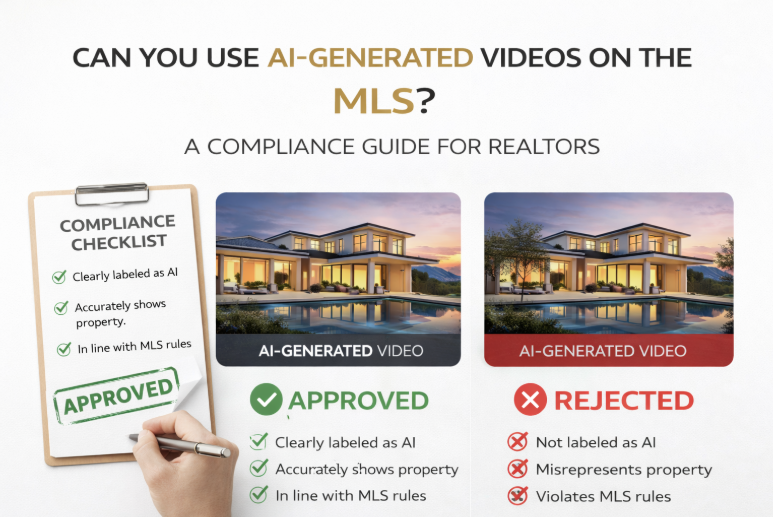
AI video MLS compliance is one of the most searched and least understood topics in real estate marketing right now. Agents across the country are producing AI-generated listing videos faster than ever — but very few know the guidelines.
Can you upload AI videos to the MLS? Do you need to disclose that a video is AI-generated? What happens if you get it wrong? This guide breaks down the MLS rules for AI-generated listing video in plain language, so you can market smarter, stay compliant, and protect your licence.
of buyer agents say visual content directly influences buyer perception (2025 NAR Profile of Home Staging)
of agents use AI tools — but confidence in AI output accuracy remains low (RPR, Feb 2026)
AI real estate videos produced by AutoReel as of December 2025, all grounded in real listing photos
What Is AI Video MLS Compliance?
AI video MLS compliance refers to the rules, disclosure requirements, and content standards that govern how AI-generated or AI-enhanced listing videos can be submitted and displayed on Multiple Listing Service (MLS) platforms.
For years, MLS boards regulated photos. Virtual staging disclosures, image accuracy rules, and fair housing guidelines were already in place. AI-generated video is now being folded into that same compliance framework, and boards are moving fast.
What this change means for agents:
MLS Rules for AI-Generated Listing Video: The Core Framework
While every MLS board has its own policies, MLS rules for AI-generated listing video follow a shared framework built on three principles.
It is the most enforced rule. Any AI-generated or enhanced video must be clearly labeled — whether through an on-screen watermark, a listing description note, or both.
It is non-negotiable. AI video MLS compliance prohibits content that misrepresents a property's actual condition. You cannot digitally remove a power line, add features that do not exist, or make rooms appear larger than they are.
It applies to video just as it does to photos. AI-generated visuals that imply demographic preferences or exclude protected classes violate federal law regardless of how the content was produced.

AI Real Estate Videos: The 3 Rules Every Realtor Must Follow
Getting AI video MLS compliance right comes down to three non-negotiable rules that apply across virtually every MLS board in the country.
Rule 01: Always Disclose AI-Generated or AI-Enhanced Content
Any video produced using AI tools must be identified as such. The 2025 NAR Profile of Home Staging confirmed that 83% of buyer agents say visual content directly influences buyer perception. Undisclosed AI manipulation erodes exactly the trust that makes video marketing effective.
Rule 02: Never Alter Permanent Property Features
AI can animate your listing photos into a cinematic walkthrough. It cannot legally change what the property actually looks like. Removing a dated bathroom, softening an awkward roofline, or making rooms appear larger than they are — all violate MLS rules for AI-generated listing videos and could expose you to serious legal liability.
Rule 03: Review Every AI Output Before Uploading
A February 2026 RPR survey of 225 real estate professionals found that 82% of agents use AI, but confidence in AI output accuracy remains low. Human review before every upload is not optional — it is your direct responsibility as the listing agent.
These three rules sound simple, but compliance looks different depending on where you practise.
How Compliance Differs Across MLS Boards
One of the most important things to understand is that AI video MLS compliance varies across the country. Miami Realtors, for example, has built a formal AI vetting process where every partner tool is reviewed for safety, fair housing compliance, and copyright protection. Other boards have not yet issued formal AI video guidance at all, creating ambiguity rather than freedom.
Steps to verify compliance with your specific MLS board:
Common Violations and How to Avoid Them
Understanding MLS rules for AI-generated listing videos is one thing. Knowing where agents actually go wrong is a different issue altogether.
Common AI video MLS compliance violations agents make:
How to stay compliant every single time:
How AutoReel Keeps Your Videos MLS Compliant
AutoReel was built specifically for real estate professionals, and AI video MLS compliance is central to the platform's design from the ground up.
Unlike general-purpose AI video tools, AutoReel generates cinematic listing videos directly from your existing property photos without fabricating environments, altering permanent features, or producing content that misrepresents the actual home.
AutoReel has produced over 85,000 AI real estate videos as of December 2025. Every video is grounded in the real photography from the listing, which means what buyers see accurately reflects what the property looks like.
Why agents trust AutoReel for compliant AI video production:
Confident Marketing: Stay Compliant with MLS Rules
AI video MLS compliance is not a barrier to great marketing. It is the foundation of it. Agents who understand MLS rules for AI-generated listing videos will always market with more confidence, more credibility, and more trust from buyers and sellers alike.
AutoReel makes that easy. Every video is built from your real listing photos, keeping your content accurate, your disclosure clean, and your MLS standing protected.
Create your first compliant AI listing video
Built from real listing photos. MLS-safe, social-ready, and produced in 10–15 minutes.
FAQ: AI Video MLS Compliance
"AutoReel transforms photos into beautiful, realistic video walkthroughs. A must-have tool for realtors in a digital-first world."
Nicole Causey
Co-Founder, Everhome Realty
"It's quick, cost-effective, and perfect for generating professional-quality videos. I can create multiple videos in minutes."
Bryce Perez
Founder, RE Media Company
"AutoReel has streamlined editing times by 25%, shortening time to listing."
Don Horn
Owner, Horn Pix Photography
"The future is here! AutoReel surpasses the rest in terms of quality and accuracy."
Kerry Riordan
Owner, Blu Lemonade Photography