Virtual Staging Disclosure Rules: What Every Realtor Should Know in 2026

Summarize with AI


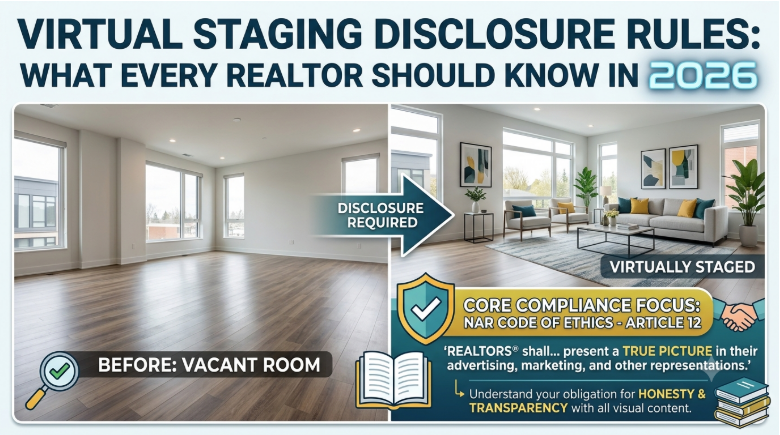
Virtual staging disclosure rules require you to clearly label any digitally staged listing photo so buyers know the furniture, decor, or room changes aren't real. Most MLS platforms and the NAR Code of Ethics treat this as a truth-in-advertising issue, not an optional courtesy.
Skip the disclosure and you're risking an MLS compliance violation, a fair housing complaint, or a Code of Ethics grievance filed by a competing agent.
Virtual staging itself is legal and increasingly standard practice, but the rules around how you disclose it vary by MLS and, in some cases, by state. Here's virtual staging disclosure rules in 2026, and how to stay compliant without slowing down your listing workflow.
What Is Virtual Staging Disclosure?
Virtual staging disclosure is the practice of labeling any listing photo that's been digitally altered to add furniture, decor, or design elements to an empty or under-furnished room. The label tells buyers the image reflects a design concept, not the property's actual current condition.
This is different from photo editing that corrects lighting, straightens verticals, or removes lens distortion. Those adjustments don't misrepresent the space itself. Virtual staging changes what's actually in the room, which is why it sits in its own disclosure category.
The disclosure usually takes one of two forms: a visible watermark or caption directly on the photo (something like "Virtually Staged") or a written disclaimer in the listing description stating that some photos have been virtually staged.
Is Virtual Staging Legal?
Yes, Virtual staging is legal in every U.S. market, and it's used by a large share of listing agents, photographers, and media companies today. There's no law banning the practice itself.
What's regulated isn't the staging, it's the disclosure. Article 12 of the National Association of REALTORS® Code of Ethics addresses this under the broader duty of honest advertising: listing photos, virtually staged or otherwise, can't misrepresent the property in a way that misleads a buyer about its actual condition.
In practice, that means an undisclosed virtually staged photo can be treated the same way as any other misleading advertising claim, opening the door to an ethics complaint even though the staging technology itself broke no law.
A handful of state real estate commissions also address virtual staging directly, generally through existing rules against misleading advertising, rather than a staging-specific law. So treat your state's advertising rules as a floor and your MLS's policy as the stricter, more specific standard.
What Do MLS Rules Require for Virtual Staging Disclosure?
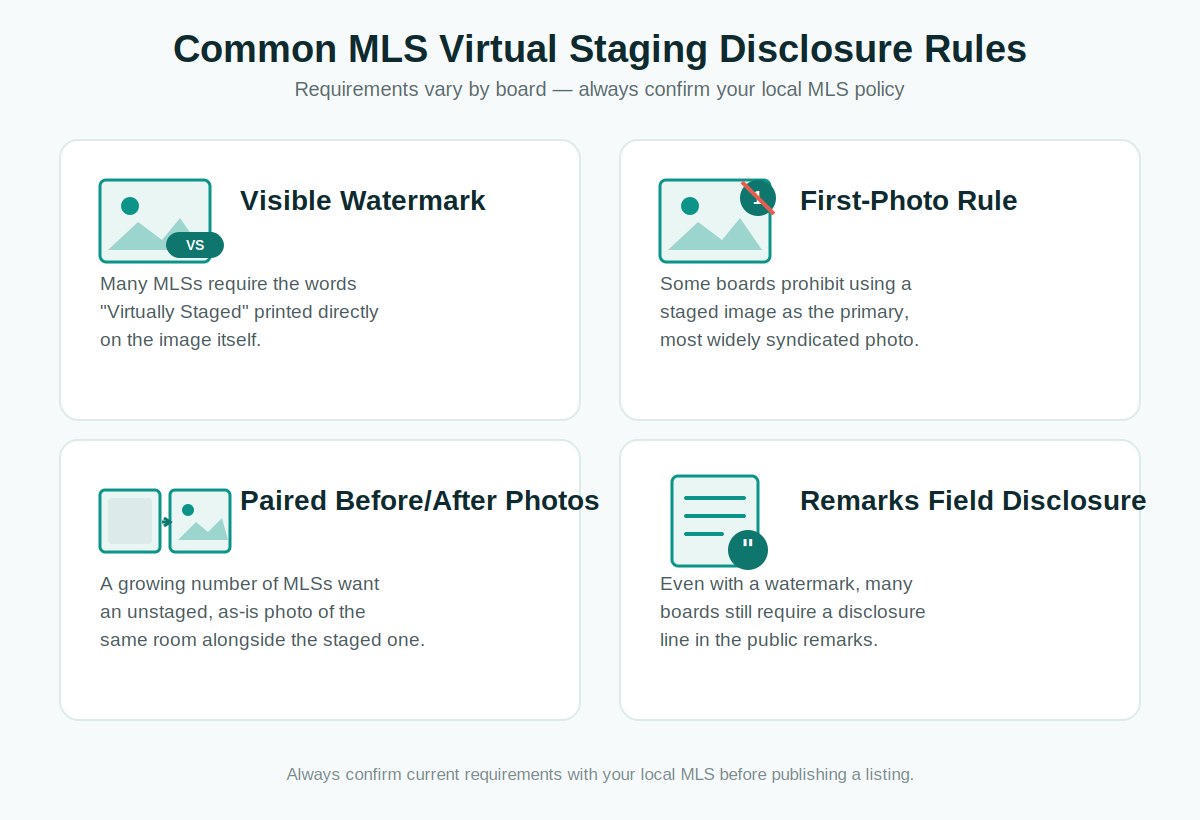
Most regional MLSs now have an explicit virtual staging policy. While the wording differs, the core requirement is consistent: any virtually staged photo must be labeled as such, either as a watermark on the image or a note in the MLS remarks field.
Common MLS requirements you'll run into:
- Visible watermark: many MLSs require the words "Virtually Staged" printed directly on the image, not just buried in the listing description.
- First-photo rule: some boards prohibit using a virtually staged image as the primary listing photo, since that's the image syndicated most widely to portals.
- Empty-room-first rule: a growing number of MLSs also require at least one unstaged, as-is photo of the same room so buyers can see the actual condition.
- Remarks field disclosure: even with a watermark, many boards still require a line in the public remarks confirming that virtual staging was used.
Because MLS rules aren't standardized nationally, the safest habit is to check your specific board's media policy before you upload, and to default to labeling every staged photo even if your MLS doesn't strictly require it.
How Does Virtual Staging Intersect With Fair Housing Law?
Virtual staging doesn't inherently create a fair housing problem, but two situations can turn it into one.
- Undisclosed staging that materially misrepresents a property's condition can be read as deceptive advertising, which regulators and courts treat seriously regardless of intent.
- Any virtual edit that alters a neighborhood's apparent demographics, adds or removes people from images, or otherwise signals a preference tied to a protected class can trigger Fair Housing Act concerns under HUD's advertising guidance.
The practical rule for realtors: virtual staging should only touch furniture, decor, and finishes. Never use editing tools, AI or otherwise, to alter people, exteriors implying who "belongs" in a neighborhood, or anything that could be read as steering.
What Should a Staged Photo Disclaimer Actually Say?
A good disclaimer is short, specific, and impossible to miss. It doesn't need legal jargon, just clarity.
Effective disclaimer language typically includes:
- A direct statement that the photo has been virtually staged.
- Confirmation that the furniture and decor shown are not included with the sale.
- A note (if applicable) that the room's actual condition may differ from the image.
For MLS remarks, something like this covers the requirement cleanly: "Photos of [room] have been virtually staged to show design potential. Furnishings are not included and do not reflect the property's current condition."
If your MLS requires an on-image watermark, keep it legible but unobtrusive, typically a corner tag reading "Virtually Staged" in a contrasting color.
Virtual Staging Ethics: Best Practices Beyond the Legal Minimum
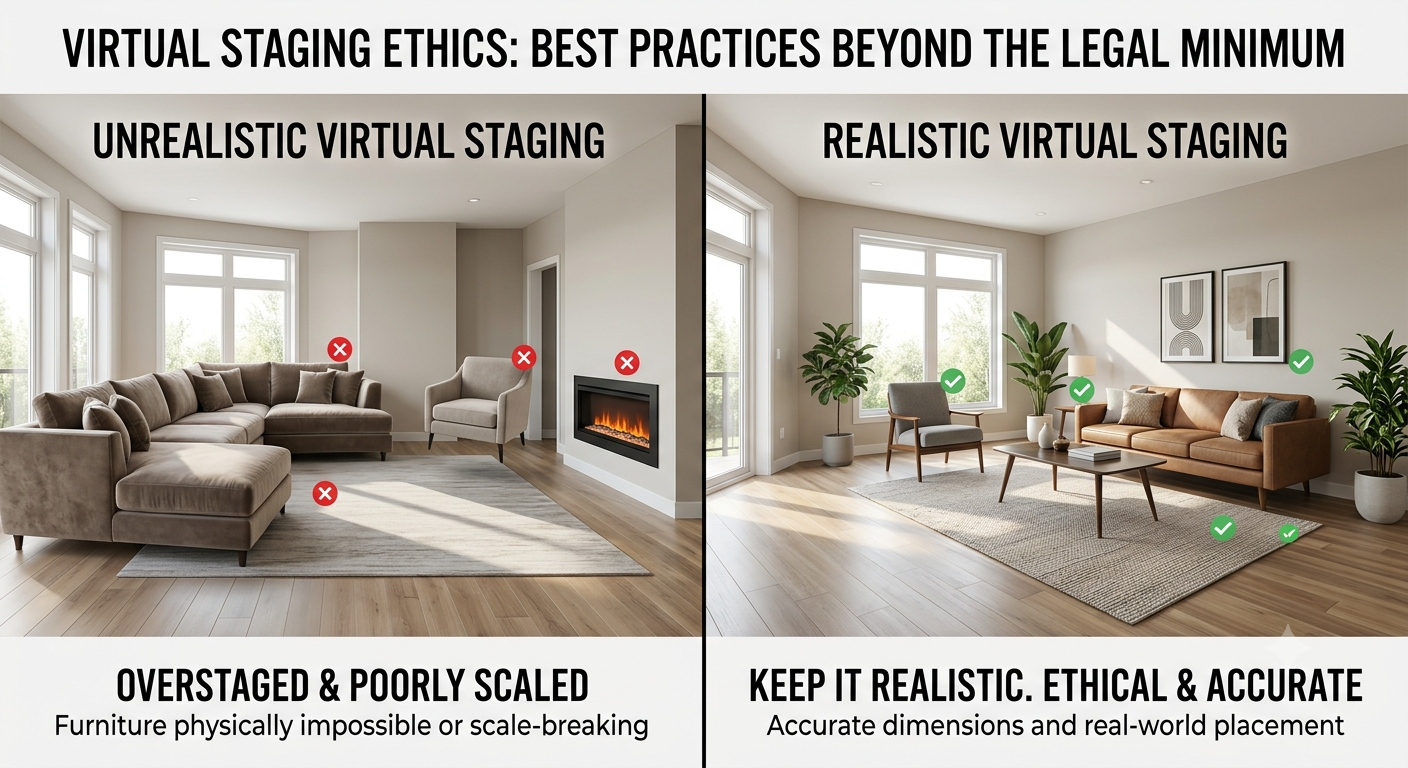
Compliance is the floor, not the ceiling. Agents who treat disclosure as a trust-building tool rather than a checkbox tend to get fewer buyer complaints and fewer awkward showings.
- Disclose even when it's not required. If your MLS doesn't mandate a watermark, add one anyway. It costs you nothing and removes any ambiguity for the buyer.
- Keep staging realistic. Don't stage a room with furniture that couldn't physically fit, or a layout that hides a structural issue. Realistic staging protects you if a buyer ever claims they were misled.
- Pair staged and unstaged photos. Showing the empty room alongside the staged version builds credibility and heads off the "that's not what I saw" conversation at the showing.
- Train your team on this once, not per-listing. If you run a team or work with a photographer, put your disclosure standard in writing so it's applied consistently across every listing - not just the ones someone remembers to flag.
How AutoReel Helps Realtors Stay Compliant
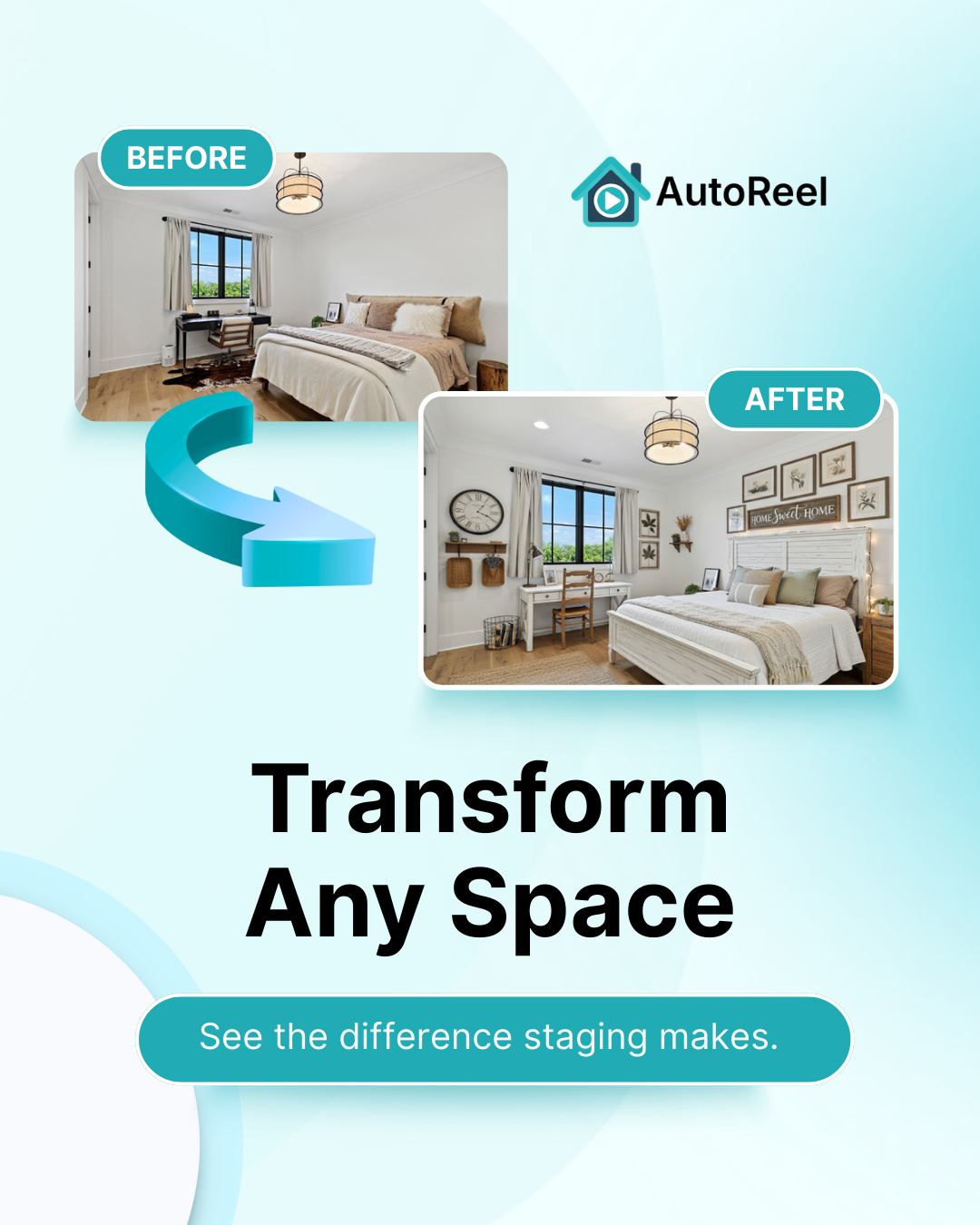
AutoReel's AI Virtual Staging tool furnishes selected empty rooms directly from your existing listing photos, and it's built with the disclosure conversation in mind rather than as an afterthought. Every plan includes a set number of AI photo edits and virtual staging edits, so the cost is predictable from month to month: 125 included annually on the Essential plan, up to 800 on Growth, and 2,000 on Pro.
If a busy listing month pushes you past your included edits, extra credits are available at the same low per-video rate, so there's no expensive one-off staging fee to negotiate mid-project.
Because AutoReel keeps your original, unstaged photos alongside the staged versions, pairing an as-is image with a staged one for MLS compliance takes seconds - not a second shoot. And since staging feeds directly into AutoReel's Photo to Video tool, the same disclosed, compliant images can go straight into a listing video without re-exporting or re-editing anything.
If you're weighing virtual staging against hiring a traditional stager, AutoReel's virtual staging page walks through the cost and turnaround difference in more detail.
The Bottom Line
Virtual staging isn't the compliance risk, silence about it is. Label every staged photo, match your MLS's specific policy, keep an as-is image on hand, and never let staging touch anything beyond furniture and decor. Do that consistently and virtual staging stays exactly what it should be: a fast, low-cost way to help buyers see a space's potential.
If you're building virtual staging into your listing workflow for the first time, AutoReel's free plan lets you test the tool with no credit card required, and the realtor-focused workflow page covers how staging fits alongside video and photo edits in a single listing package.
FAQs
Do I legally have to disclose virtually staged photos?
In most cases, yes, either because your state's advertising rules prohibit misleading claims or because your MLS has an explicit virtual staging policy. Even where no specific rule exists, NAR's Code of Ethics duty of truthful advertising effectively requires it.
What happens if I don't disclose virtual staging?
You risk an MLS compliance violation, a Code of Ethics complaint from a competing agent or consumer, and, in a worst case, a fair housing or deceptive advertising claim if a buyer argues they were materially misled.
Does virtual staging have to be watermarked on the photo itself?
It depends on your MLS. Many boards require an on-image watermark like "Virtually Staged," while others accept a disclosure in the listing remarks. Check your specific MLS's media policy rather than assuming a national standard.
Can virtual staging cause a fair housing issue?
The staging of furniture and decor generally does not. Risk arises when edits go beyond furnishings, for example, altering people in a photo or anything that could be read as signaling who belongs in a neighborhood. Keep AI edits limited to interior furnishings and finishes.
Is virtual staging cheaper than traditional staging?
Yes, traditional staging involves renting and physically placing furniture, which typically costs more and takes longer to arrange than an AI tool that furnishes a room from existing photos in minutes.
Do I need to show both the staged and unstaged photo?
It's not universally required, but it's becoming more common as an MLS best practice, and it's good protection for you as the listing agent. Pairing the two photos removes any ambiguity for the buyer before they ever schedule a showing.
Sources
https://www.nar.realtor/sites/default/files/2025-12/2026-COE-Standards-of-Practice-2026-01-01.pdf
https://www.styldod.com/blog/legal-and-ethical-concerns-in-virtual-staging